




Table of contents
First Rule: Pretty Much Anything Can Be a Wall The Wall Needs to Act Like a Wall Which Brings Us to the Elephant The Elephant Also Teaches Us Something Important What About Using a Tree as a Sukkah Wall? Glass Walls: Because Apparently Privacy Was Optional Could Water Be a Sukkah Wall? You Don't Actually Need Four Walls for a Sukkah What If the Sukkah Walls Need Replacing? So What Actually Makes a Good Sukkah Wall? The Bottom Line
Glass walls, living walls, water walls, and one very large elephant walk into a Sukkah. Here's where halacha draws the line.
There are normal questions about Sukkah walls.
How high should the Sukkah walls be?
Can they be made from fabric?
Then there are the questions that make you stop halfway through your coffee and think:
Wait. An elephant?
Yes.
The Talmud actually discusses whether a living animal can serve as a Sukkah wall. And once you've opened that particular door, it turns out the possibilities get increasingly creative.
Could a tree be a wall? Apparently.
A person? Also apparently.
Glass? Possibly.
Flowing water? Now we're getting ambitious.
The good news is that you don't need to start rounding up zoo animals to build a kosher Sukkah. But these unusual examples reveal something genuinely useful about what makes a Sukkah wall a wall in the first place.
And, as usual, halacha has a few more opinions about that than one might expect.
First Rule: Pretty Much Anything Can Be a Wall
Here's the surprisingly broad starting point.
Unlike Schach – the natural roofing material on top of the Sukkah, which has specific requirements – the walls are much less fussy.
The Shulchan Aruch states that all materials can be used for Sukkah walls, subject to the relevant requirements for a valid partition [Shulchan Aruch, Orach Chaim 630:1].
Wood? Fine.
Canvas? Fine, provided it's properly secured.
Metal? Fine.
Glass? Well...keep reading.
An animal? We're getting there.
The important distinction is that the material itself isn't usually the star of the show.
Stability is.
The Wall Needs to Act Like a Wall
A Sukkah wall can't simply exist in the general vicinity of the Sukkah and hope for the best.
It needs to remain a valid mechitzah, meaning a halachic partition or boundary.
And one of the key requirements is that it be able to withstand a ruach metzuyah – a normal or ordinary wind.
If the wind comes along and the wall starts enthusiastically waving hello, that's a problem. The Gemara discusses this principle in connection with tree branches used as walls, and the Shulchan Aruch codifies it [Sukkah 24b; Shulchan Aruch, Orach Chaim 630:10].
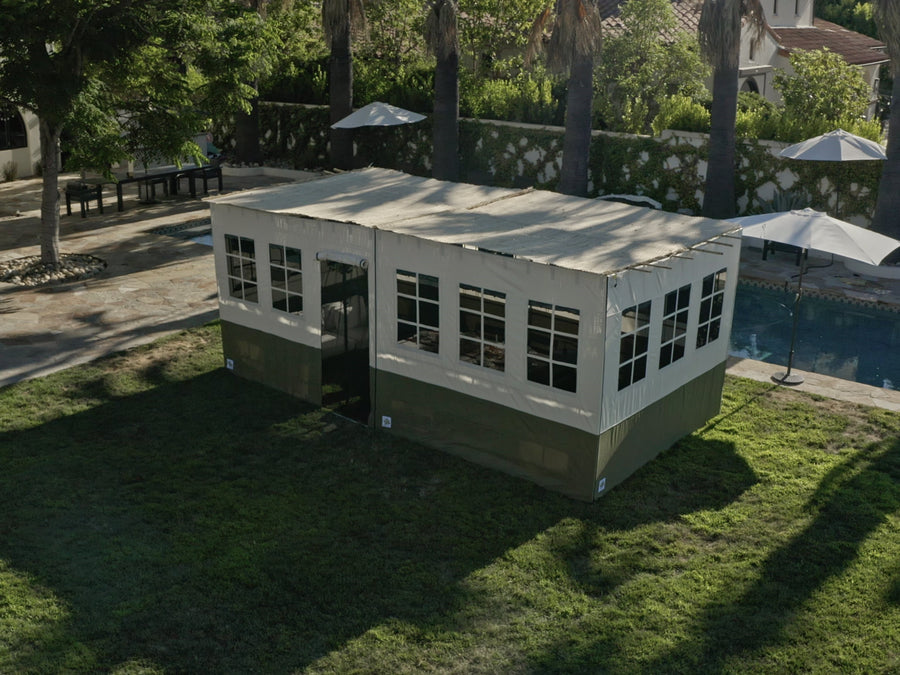
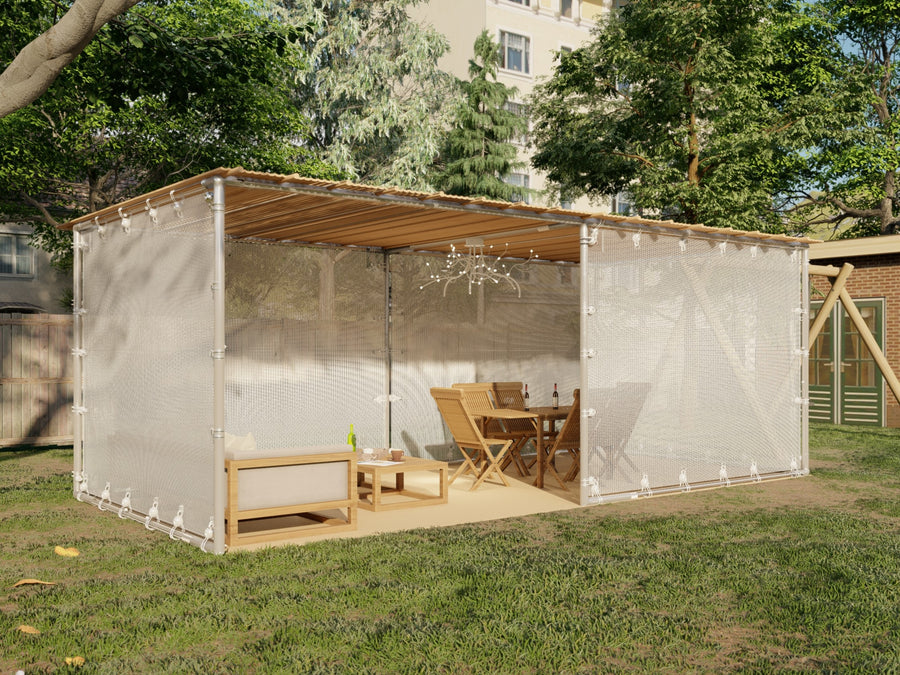
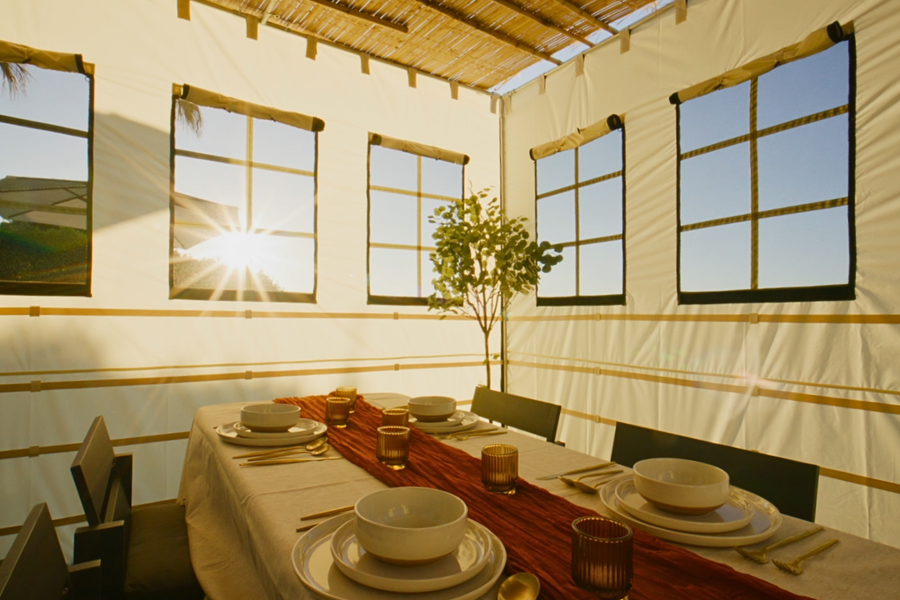
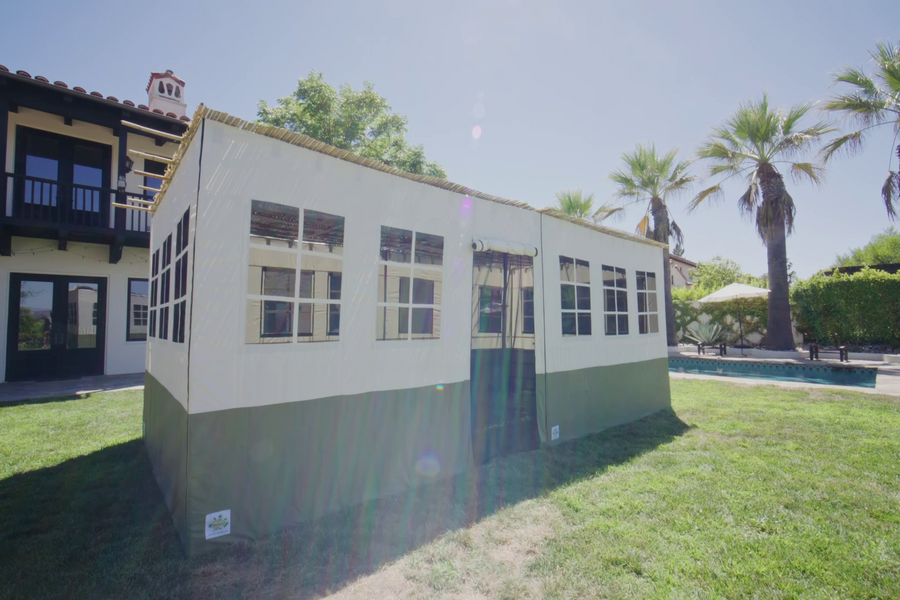
This is why flimsy sheets simply tied at the corners can be problematic, while modern fabric Sukkahs with properly secured walls can be perfectly acceptable.
The question isn't: "Is this material fancy enough?"
It's: "Will this thing still be a wall when the wind starts doing wind things?"
Which Brings Us to the Elephant
The elephant question sounds like someone got bored during a shiur and decided to see what would happen.
But it is, in fact, a genuine Talmudic discussion.
The Gemara in Sukkah 23a considers whether an animal can serve as a Sukkah wall. One concern is that the animal might die; another is that it might escape. But when it comes to a tied elephant, the Gemara says everyone agrees that it can serve as a valid wall, because even if the elephant dies, its carcass would still have the required height of ten tefachim (handbreadths) [Talmud, Sukkah 23a].
Yes.
The Talmud really did spend time making sure the elephant contingency plan was covered.
And halacha follows the principle that living things can serve as walls, provided the relevant conditions are met. The Shulchan Aruch explicitly states that an animal can be used as a Sukkah wall if it is tied so that it cannot wander away [Shulchan Aruch, Orach Chaim 630:11].
So technically? Elephant Sukkah: possible.
Practical recommendation? Probably not.
The Elephant Also Teaches Us Something Important
The whole elephant discussion isn't really about elephants.
It's about stability.
If the wall disappears halfway through the meal because it decided to go find some peanuts, you've got a problem.
Which is why the tied elephant works.
It's not going anywhere.
At least not without assistance.
And if it dies, the Gemara even considers whether the remaining carcass would still provide enough height to function as a wall.
This is the sort of detail that makes a person feel very grateful that their own Sukkah is made from galvanized steel and fabric.
What About Using a Tree as a Sukkah Wall?
Trees make much more sense as Sukkah walls.
In fact, the halachic literature explicitly discusses building a Sukkah between trees and using the trees as the walls.
But once again, the trees need to be strong enough – or securely tied and reinforced enough – that an ordinary wind doesn't cause them to sway significantly [Shulchan Aruch, Orach Chaim 630:10].
This is also why the gaps between branches may need to be filled in with materials such as straw or hay and secured properly.
So if someone looks at a beautiful stand of trees and thinks:
"Perfect. The forest has already built my Sukkah."
Well...almost.
The forest still needs a little supervision.
Glass Walls: Because Apparently Privacy Was Optional
Now for a much more realistic question.
Can a Sukkah have completely transparent walls?
At first glance, glass seems like an obvious choice.
It's solid.
It doesn't flap around.
It doesn't blow away.
It lets in plenty of light.
And if the Sukkah happens to overlook a particularly nice view, you've just upgraded your Sukkot dining experience considerably.
There are sources supporting the use of transparent walls, since the walls of a Sukkah can generally be made from any material and transparency itself isn't listed as a disqualifying feature [Shulchan Aruch, Orach Chaim 630:1].
But there is an interesting wrinkle.
The Gemara in Sukkah 4b discusses the need for mechitzot ha-nikarot – recognizable or noticeable walls. This has led some authorities to question whether completely invisible or imperceptible walls would satisfy the requirement [Sukkah 4b].
In other words, there's a difference between: "You can see through the wall."
and, "Where exactly is the wall?"
The first is glass.
The second is a problem.
There are also differing approaches regarding whether transparent walls can provide the kind of "shade" relevant to certain Sukkah requirements. So an all-glass Sukkah is not necessarily the straightforward architectural masterpiece it first appears to be.
Still, as a practical matter, the halachic discussion is much more nuanced than simply saying "glass = invalid."
Could Water Be a Sukkah Wall?
Now we're entering the territory of please don't try this at home.
The idea is actually rather beautiful.
Imagine a Sukkah surrounded by flowing water, perhaps inspired by the walls of water at the splitting of the Red Sea.
It's also symbolically rich: water is associated with Torah, Sukkot includes the ancient water-drawing celebration, and the imagery of water surrounding the Jewish people is right there in the Torah.
The problem?
Water is notoriously bad at standing still.
And Sukkah walls need to function as stable partitions.
The Gemara's discussion of Sukkah walls emphasizes the requirement that a wall withstand ordinary wind without becoming an invalid, moving partition [Sukkah 24b].
Flowing water presents an even more basic question: can constantly moving water function as a halachically valid mechitzah at all?
There are also broader halachic discussions about whether bodies of water can constitute a valid boundary in other contexts, such as eruvin – the laws governing carrying between certain areas on Shabbat.
So while the mental picture of a Sukkah surrounded by elegant sheets of flowing water is fantastic...
the halachic and engineering departments have both submitted objections.
You Don't Actually Need Four Walls for a Sukkah
Here's another useful detail hiding underneath all these unusual examples.
A kosher Sukkah doesn't necessarily need four complete walls.
The basic halachic structure can be achieved with three walls, using the detailed rules of Sukkah partitions and configurations [Shulchan Aruch, Orach Chaim 630:2–3].
Which means there is usually no need to panic when designing the entrance.
The Sukkah doesn't need to become a fortified bunker.
It just needs enough valid partitions in the right configuration.
And yes, there are even technical methods involving small sections of wall and tzurat ha-petach, literally a "form of a doorway," to complete certain configurations [Shulchan Aruch, Orach Chaim 630:2–3].
Halacha has basically invented architectural hacks.
Long before anyone invented Pinterest.
What If the Sukkah Walls Need Replacing?
Here's where things get surprisingly practical again.
Suppose the Sukkah is already standing.
The Schach is already on.
Then one wall needs replacing.
So someone removes one wall and immediately installs a replacement.
Then another. And another.
Does the Sukkah remain kosher?
The key issue is a principle called ta'aseh velo min ha-asui – roughly, "you shall make it, rather than having it be made already."
The concern is that the Sukkah needs to be constructed in the proper way, rather than becoming kosher retroactively because the necessary components happen to be there afterward.
The Rema (Rabbi Moshe Isserles) writes that the Schach should not be put up before the walls [Rema, Shulchan Aruch, Orach Chaim 635:1].
But the Mishnah Berurah explains the underlying issue: when the Schach is put in place, it needs to be functioning as the roof of an ohel, meaning a tent-like structure or enclosure. If there are no walls at that point, it isn't functioning as that structure yet [Mishnah Berurah 635:9].
That sounds like very bad news for the wall-replacement scenario.
Except...
If the Sukkah already had valid walls when the Schach was put up, and the walls are then replaced one at a time, with the Sukkah never losing its minimum number of valid walls, there is an argument that the original requirement was already satisfied.
The roof was functioning as the roof of a Sukkah.
Then the walls were gradually replaced.
The Sukkah never became a roof floating above an empty patch of ground.
Which means that, according to the reasoning presented in the source, replacing the walls one at a time would not create the same problem [Mishnah Berurah 635:9].
A useful piece of information for anyone whose Sukkah walls have ever needed emergency repairs approximately five minutes before guests arrive.
So What Actually Makes a Good Sukkah Wall?
After all this, the answer is almost refreshingly boring.
A good Sukkah wall should:
Be made from an acceptable material. [Shulchan Aruch, Orach Chaim 630:1]
Be stable enough to withstand an ordinary wind. [Shulchan Aruch, Orach Chaim 630:10]
Meet the minimum dimensions and configuration required for a Sukkah.
Remain securely in place throughout use.
And, ideally, not require a zoo membership.
The fact that an elephant can be a wall doesn't mean an elephant is the best wall.
Likewise, the fact that glass may be usable doesn't mean everyone should immediately replace their Sukkah panels with floor-to-ceiling windows.
And while a flowing-water Sukkah would undoubtedly win the neighborhood award for "Most Likely to Cause a Halachic Discussion," there are considerably easier ways to build three walls.
The Bottom Line
Sukkah walls are remarkably flexible.
They can be wood.
Fabric.
Trees.
And, under the right conditions, apparently even elephants.
What matters is less about the material and much more about whether the thing actually functions as a mechitzah – a stable halachic partition.
That is why a beautifully designed fabric Sukkah can be completely kosher while a theoretically impressive wall of moving water leaves everyone with questions.
It also explains why modern Sukkah walls can use materials that would never qualify as Schach. The requirements for walls and roofing are simply different.
So the next time someone asks what a Sukkah wall can be made from, there is a perfectly accurate answer: Almost anything.
Then, if they look particularly interested, mention the elephant.
Just don't tell them they need one.