




Table of contents
The Sukkah Has Rules About Its Origin Story You Don't Need the Whole Wall. You Just Need a Little Wall. The “tiny wall” loophole But What If the Roof Is Already There? Now for the Plot Twist: Does a Jew Have to Build the Sukkah? But There's a Difference Between “Kosher” and “Ideal” The Schach Is Where You Might Want to Get Involved So, Does the Sukkah Have to Be Built From the Bottom Up?
There are two kinds of people when it comes to building a Sukkah.
The first kind starts weeks in advance, checks the weather forecast approximately 47 times, labels every pole, and has strong opinions about where the decorations should go.
The second kind looks at the Sukkah on the afternoon before Sukkot and thinks:
“How hard can this be?”
And honestly, sometimes the second person has a point.
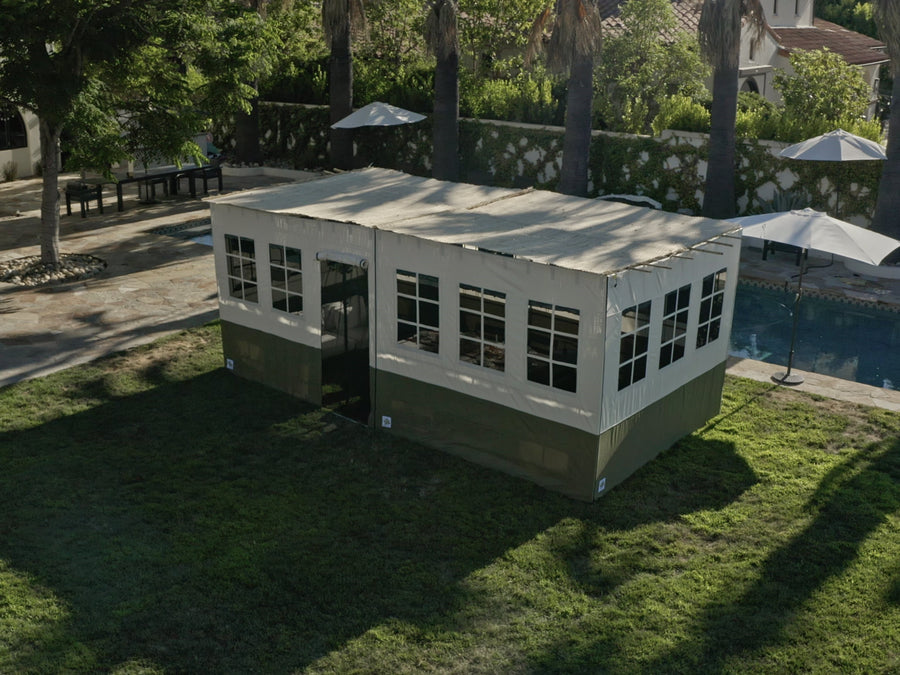
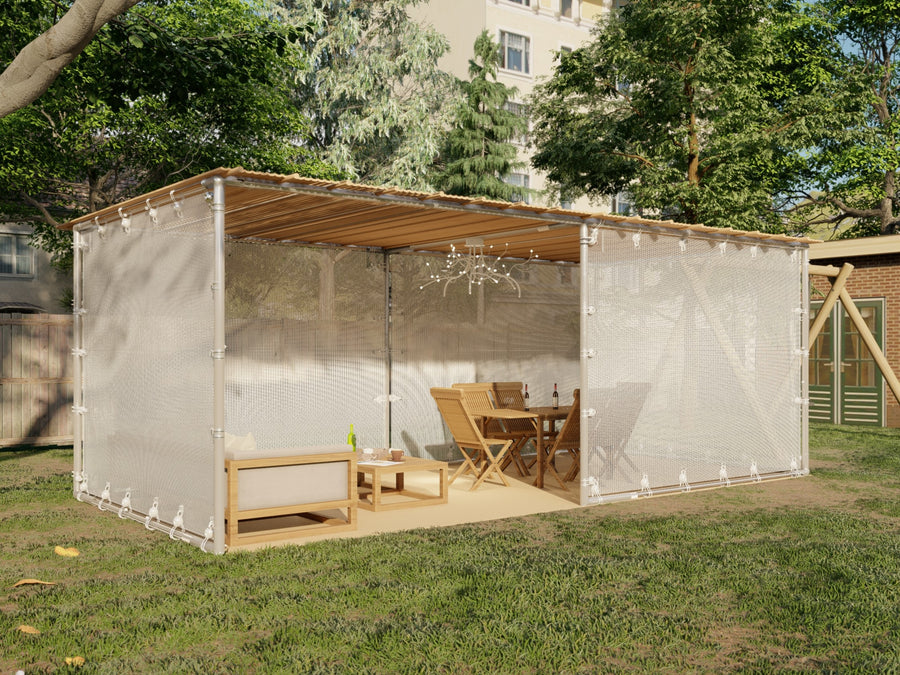
A Sukkah is, after all, a temporary dwelling. It doesn't need a foundation, a mortgage, or a municipal zoning hearing. It needs walls, Schach – the roof covering – and enough halachic engineering to make sure the whole thing qualifies as a Sukkah rather than an ambitious backyard gazebo.
But there are some surprisingly specific rules about how the Sukkah comes into existence.
Can the roof go up first?
Can someone else build the whole thing?
And if a non-Jewish worker assembles the entire Sukkah while the Jewish owner stands nearby holding a coffee, is that Sukkah kosher?
The answers are considerably more interesting than “just build the walls first.”
The Sukkah Has Rules About Its Origin Story
At first glance, it seems like the order shouldn't matter.
If a Sukkah eventually has kosher Schach and kosher walls, who cares which one went up first?
Halacha, it turns out, cares.
The underlying principle is called ta'aseh velo min ha-asui.
That's Hebrew for roughly: “You shall make it, rather than have it become made on its own.”
The idea is that the Sukkah has to be actively constructed as a Sukkah. It shouldn't merely become a kosher Sukkah because someone happened to put some walls around something that was already sitting there.
The Talmud discusses this principle in connection with a rather memorable scenario: someone takes a haystack and hollows out a space inside it to make a Sukkah. The problem is that the haystack wasn't originally constructed as Schach for a Sukkah. The Sukkah essentially appeared afterward by excavation. That's not quite the active construction the Torah requires (Sukkah 16a).
So if someone is standing there with a perfectly good roof and thinking, “I'll just add the walls later,” halacha has a small administrative note to add.
And that note involves one very small measurement.
You Don't Need the Whole Wall. You Just Need a Little Wall.
The Rema – Rabbi Moshe Isserles, whose rulings are especially significant for Ashkenazi practice – addresses the question in Orach Chaim 635.
The basic rule is that the Schach shouldn't be put up before the walls.
But there is an exception.
If at least one tefach of wall – one tefach, a halachic unit of roughly a handbreadth – already exists next to the Schach, the Schach can be placed before the rest of the wall is finished [Rema, O.C. 635:1].
In other words, halacha does not require the Sukkah builder to construct an entire fortress before touching the roof.
One little piece of wall can be enough to establish that the Schach is being placed as the roof of a Sukkah.
Which is useful, because apparently even halachic Sukkah construction has a minimum viable product.
The “tiny wall” loophole
Imagine a Sukkah frame that already has its basic supports.
A person puts up a small section of wall – at least a tefach – and then puts up the Schach. The rest of the walls can be completed afterward.
That's acceptable according to the Rema's ruling [O.C. 635:1].
The Mishnah Berurah explains the logic: when the Schach is put up, it needs to be functioning as the roof of an ohel – a structure or enclosure. Without any walls, it's just a roof floating over the future site of a Sukkah. With the requisite wall section already there, it can be considered part of an actual shelter [Mishnah Berurah 635:9].
So, technically speaking, the Sukkah does not have to be built completely from the bottom up.
It just needs to have enough of a bottom to prove that the top is actually a roof.
But What If the Roof Is Already There?
This becomes particularly relevant when someone encounters a pre-existing structure.
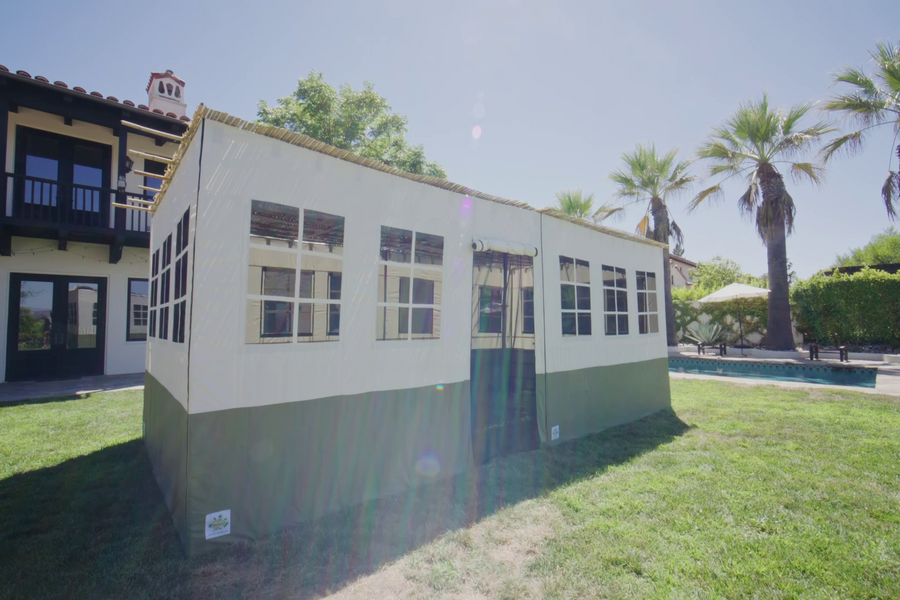
Say there's an open-sided tropical-style hut – a palapa, for example – with perfectly acceptable plant material already serving as Schach.
Could someone simply attach canvas walls around it and declare:
“Congratulations. You're a Sukkah now.”
Not quite so fast.
If the Schach went up before there was any qualifying wall structure, the ta'aseh velo min ha-asui issue can arise.
But if there was already at least a tefach of qualifying wall structure when the Schach was installed, the situation can be different [Rema, O.C. 635:1].
And this is where Sukkah construction starts feeling less like assembling patio furniture and more like solving a very specific Jewish escape room.
Was there a wall?
How much wall?
Was it there before the Schach?
Does that pole count?
What exactly is a palapa?
The last question may not be halachically significant, but it is still a reasonable one.
Now for the Plot Twist: Does a Jew Have to Build the Sukkah?
Here's another surprisingly practical question.
Many synagogues and communities hire workers to assemble their Sukkahs. Sometimes the worker is Jewish. Sometimes he isn't.
So what happens if a non-Jew builds the entire Sukkah?
Is the Sukkah automatically invalid? No.
The Talmud is remarkably explicit about this.
In Sukkah 8b, the Sages list several unusual categories of Sukkahs that are kosher, including a Sukkah built by non-Jews. The key condition is that it must be properly mesuchach – covered with valid Schach – and Rav Chisda explains that the Sukkah needs to have been made for the purpose of providing shade [Sukkah 8b].
The Shulchan Aruch follows this ruling: a Sukkah is valid even if it wasn't specifically constructed for the mitzvah of Sukkot, as long as it was made for shade [O.C. 635:1].
So the halachic nightmare scenario of:
“Wait. The guy who built the Sukkah wasn't Jewish. Do we have to tear the whole thing down?”
is, thankfully, generally a no.
The Sukkah doesn't need a Jewish construction crew to become a Sukkah.
But There's a Difference Between “Kosher” and “Ideal”
Here's where things get a little more nuanced.
Although a Sukkah built entirely by a non-Jew can be kosher, some authorities recommend that a Jew participate in the construction when possible.
Why?
Because there is a concept that, when performing a mitzvah, it is preferable for the person who is obligated in that mitzvah to participate in making it.
The practical recommendation found in some later sources is wonderfully low-drama: if a non-Jew has built the Sukkah, a Jew can do something small to participate in its construction – such as lifting up and replacing a bit of the Schach [Be'er Heitev, O.C. 635; see also Mishnah Berurah discussions cited in the Q&A].
And we're not talking about rebuilding the Sukkah.
No need to suddenly develop carpentry skills at 4:47 p.m. on Erev Sukkot.
Just make a small, meaningful contribution.
Some later halachic discussions are even more lenient where a non-Jewish worker was hired by a Jew, because the worker's labor can be regarded as being performed on behalf of the employer.
So the Jewish owner doesn't necessarily need to personally tighten every bolt, straighten every pole, and discover that the instructions have mysteriously disappeared.
The Schach Is Where You Might Want to Get Involved
If there's one part of the Sukkah that deserves particular attention, it's the Schach.
That's the roof covering that makes the Sukkah a Sukkah rather than a very festive outdoor room.
The Schach needs to be made from appropriate natural materials and placed in accordance with the halachic requirements. And because the Sukkah's roof is central to its identity, some sources specifically recommend having a Jew participate in putting up at least part of it when a non-Jew has constructed the rest of the Sukkah.
That can be as simple as putting down a small section – or, depending on the halachic approach being followed, lifting and replacing part of the existing Schach.
It's a lot easier than rebuilding the walls.
And significantly less likely to result in someone discovering that they have accidentally built a rhombus.
So, Does the Sukkah Have to Be Built From the Bottom Up?
Not exactly.
The practical takeaway from these sources is more nuanced:
The walls should generally precede the Schach.
That's the standard way to build the Sukkah, and it avoids the problem of ta'aseh velo min ha-asui [Rema, O.C. 635:1].
But you don't necessarily need all the walls first.
The Rema permits putting up the Schach once there is at least a tefach of wall adjacent to it [O.C. 635:1].
A Sukkah built by a non-Jew can be kosher.
The Talmud explicitly permits a Sukkah built by non-Jews, provided it meets the relevant requirements – particularly that it was made for shade [Sukkah 8b].
But Jewish participation can still be preferable.
Some later authorities recommend that a Jew perform at least a small part of the construction, particularly with the Schach, when practical.
So if the neighborhood handyman builds your Sukkah while you stand there holding the instructions and saying, “Looks good to me,” don't panic.
The Sukkah may be perfectly kosher.
But if you can put down a little Schach yourself?
That's probably a nice idea.
After all, Sukkot is supposed to be about actually dwelling in the Sukkah – not merely outsourcing the entire holiday to someone with a cordless drill.
And there is something fitting about getting your own hands involved, even if your contribution amounts to one small piece of Schach and a very confident:
“There. I built the Sukkah.”