







Table of contents
Sukkot has a funny way of looking simple and then quietly turning into one of the most intellectually mischievous holidays on the calendar.
Build a hut. Grab four plants. Eat outside. Easy.
Until someone asks why you’re allowed to add extra plants to a biblical commandment. Or how a “kosher” Sukkah can be missing entire walls and still pass inspection. Or why a tradition exists claiming Moshe Rabbeinu somehow sourced his etrog from Italy – despite Italy not exactly featuring in Sefer Shemot (Book of Exodus).
Welcome to Sukkot, where halacha is precise, flexible, and unapologetically weird in all the best ways.
The Four Species: When Adding Isn’t Adding
Let’s start with the Arba Minim – literally, “the Four Species.”
They are:
Etrog – citron (that bumpy yellow fruit everyone inspects like a diamond)
Lulav – palm branch
Hadassim – myrtle branches
Aravot – willow branches
The Torah commands taking these four together on Sukkot (Leviticus 23:40). So far, so good.
Now comes the plot twist: some communities – most famously Chabad – add extra myrtle branches. Immediately, alarm bells go off. Isn’t there a biblical prohibition called Bal Tosif – “do not add to the commandments” (Deuteronomy 13:1)?
Yes. And also: no problem at all.
Here’s the key: the Torah is wildly inconsistent about numbers.
For the etrog and lulav, the language is singular. One fruit. One palm. No wiggle room. Add a second etrog and you’ve officially crossed into halachic chaos.
But when it comes to myrtles (anaf etz avot) and willows (arvei nachal), the Torah uses plural language – without telling us how many. The sages establish a minimum (three myrtles, two willows), but no maximum.
That loophole isn’t accidental.
Classic authorities explicitly say you may add more myrtles or willows to beautify the mitzvah. Rambam writes this straight out: extra branches enhance the mitzvah rather than violate it (Hilchot Lulav 7:7). The Mishnah Berurah explains that Bal Tosif only applies when you exceed a fixed number – and here, none exists (Mishnah Berurah 651:59).
Chabad custom is to add extra myrtles only, not willows. Other communities, including Yemenite Jews, historically went full botanical maximalist, packing in greenery until the bundle looked more like a shrub than a ritual object (Saadia Gaon; Maharitz).
Bottom line: you’re not “adding a mitzvah.” You’re upgrading it.
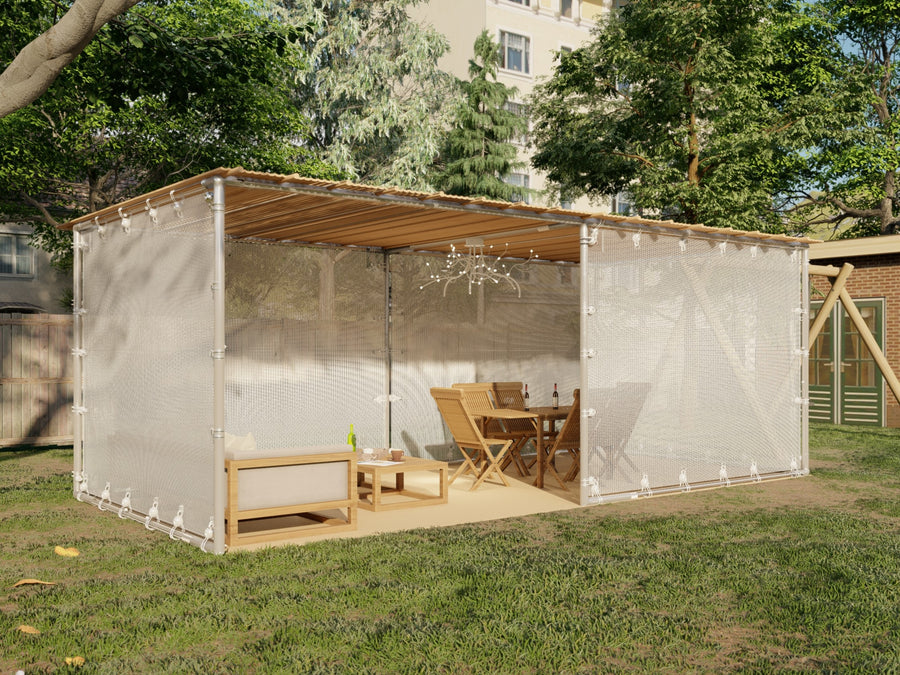
The Sukkah With Missing Walls (Yes, This Is Allowed)
Now let’s talk real estate.
The Talmud allows a kosher Sukkah with:
Two full walls and a partial third, or
Three walls, one of which is basically doing the bare minimum
Which raises a fair question: who calls this a building?
Sukkot commemorates the Clouds of Glory – divine protection that surrounded the Israelites in the desert on all sides. And the Torah describes the mitzvah as “teshvu ke’ein taduru” – “dwell as you live” (Leviticus 23:42).
So how does a semi-enclosed shack qualify as a dwelling?
Here’s the trick: the Sukkah is designed to almost feel like a house – and then fail just enough to make a point.
The prophets describe a Sukkah as something that provides shade from heat and shelter from wind and rain (Isaiah 4:6). But halacha insists that the roof (Schach) must not fully protect from rain. If it does, congratulations – you built a house, and it’s invalid.
Walls, then, are functional, not aesthetic. You don’t need four of them to block wind. Direction matters. Partial barriers work. The Sukkah only needs to feel stable enough to inhabit – not secure enough to forget why you’re there.
And teshvu ke’ein taduru? That rule isn’t about architecture. It’s about behavior. Eat there. Sit there. Make it your temporary home – even if it looks like it could blow away with a strong breeze (Sukkah 28b–29a).
The Sukkah isn’t incomplete by accident. It’s incomplete by design.
The Italian Etrog and the Moses Myth (Sort Of)
Now for the crowd favorite.
There’s a widely known tradition – especially in Chabad circles – that Italian etrogim are preferred because of their mesorah, an unbroken tradition. Somewhere along the line, this turned into the claim that Moshe Rabbeinu himself used an Italian etrog.
Did he? Is there an ancient source? A midrash? A footnote in Exodus?
No. And the sources are refreshingly upfront about that.
The earliest clear reference appears in a 1957 letter from the Lubavitcher Rebbe, who presents it explicitly as a received tradition – not a documented historical fact (Igrot Kodesh, vol. 16).
So where does it come from?
Part of the logic traces back to Rashi on Genesis 27:39. When Isaac blesses Esau with “the fat places of the earth,” Rashi cites a Midrash identifying this phrase with Italy, describing it as unusually fertile (Bereishit Rabbah).
From there, the idea develops naturally: if Italy represents the choicest produce in the world, then the most beautiful etrogim would come from there. And since beauty – hiddur mitzvah – matters deeply in Sukkot, Italian etrogim became associated with authenticity, continuity, and trust.
Over time, that trust became mesorah. Not “Moses booked a ship to Calabria,” but “this is a tradition we don’t mess with.”
In Jewish terms, that distinction matters.
Sukkot’s Real Message: Precision Without Rigidity
Put all this together, and a pattern emerges.
Sukkot is a holiday that loves structure – but hates stiffness. It defines minimums, not maximums. It insists on rules, then builds flexibility right into them. It invites people to dwell fully in something intentionally fragile.
Add greenery – but only the right kind.
Build walls – but don’t get too comfortable.
Honor tradition – but don’t pretend it’s a museum exhibit.
Sukkot doesn’t ask for perfection. It asks for presence.
And if that presence includes a slightly lopsided Sukkah, an overachieving lulav bundle, and an Italian etrog with a great backstory? Even better.
That’s not breaking the rules.
That’s understanding them.