




Table of contents
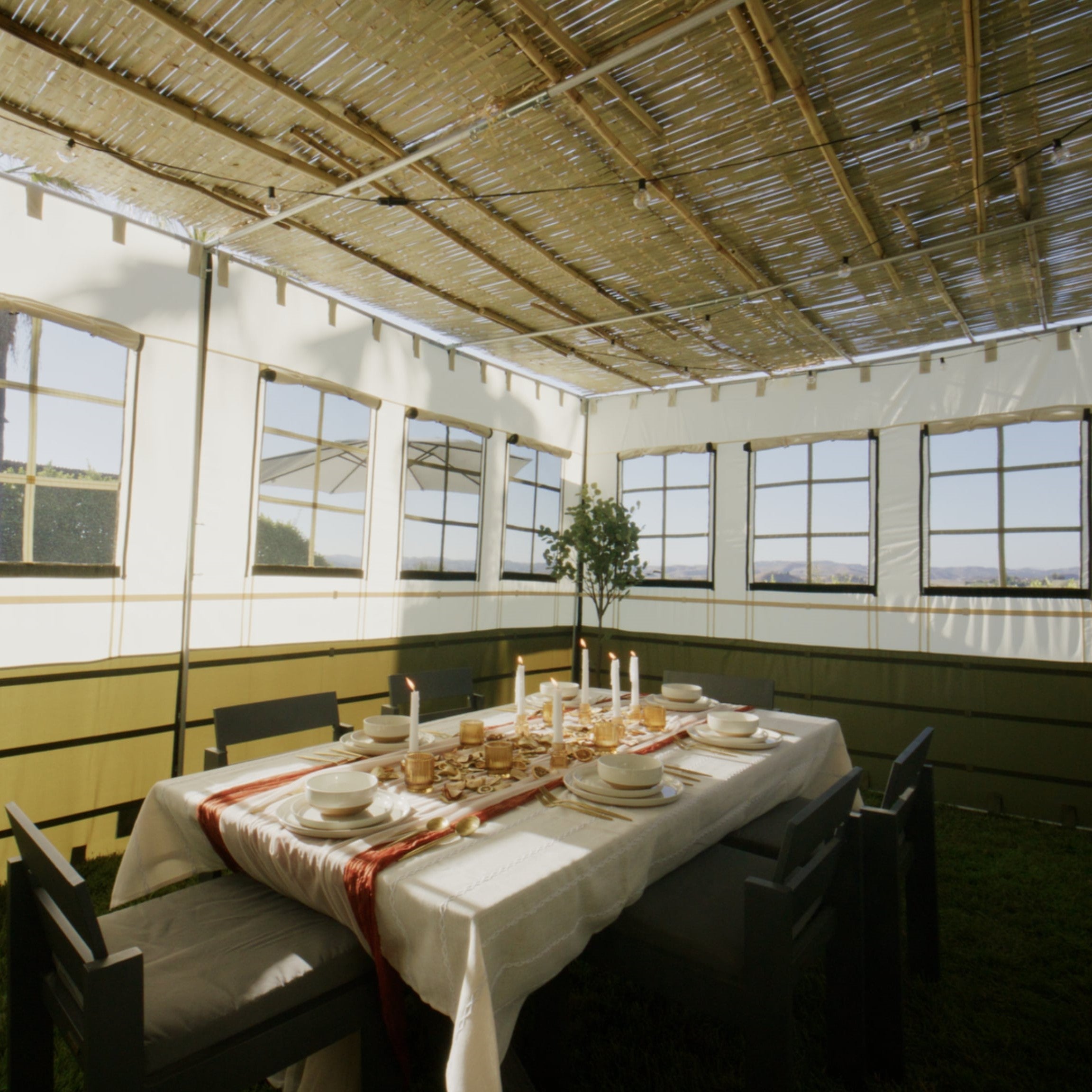
Sukkot has no shortage of classic questions, but some only come up if you’re really committed – or really comfortable. What happens if someone enters the Sukkah on the first day of the holiday, says leishev baSukkah (the blessing “to dwell in the Sukkah”), and then simply…stays? No stepping out. No breaks. Just uninterrupted Sukkah life.
When night falls and the second day of Yom Tov begins outside Israel, a surprisingly tricky question emerges: has anything actually changed? And if the calendar has turned, does the blessing need to start all over again?
What If You Never Left the Sukkah?
Imagine this scenario:
Someone enters the Sukkah on the first day of Sukkot, says leishev baSukkah, eats, relaxes… and never leaves. No interruptions. No break. Then night falls, and suddenly it’s the second night of Yom Tov (outside Israel).
Do they say leishev baSukkah again?
Instinctively, many people would say yes. After all, the second day outside Israel exists because of sfeika deyoma – uncertainty about which day is really the holiday. From that perspective, yesterday might not have been Sukkot at all.
So shouldn’t the blessing reset?
Continuity vs. Calendar Confusion
Here’s where halachic thinking gets subtle.
Several major authorities assume that no new blessing is said if one’s stay in the Sukkah was continuous – even across days (Igrot Moshe, O.C. 4:101; Mishnah Berurah 639:47).
Why?
Because leishev baSukkah isn’t tied to a specific calendar date in the same way Kiddush or Shehecheyanu is. It’s a blessing on the act of dwelling. As long as that dwelling was never interrupted, the blessing continues to “cover” the experience.
In other words, the Sukkah doesn’t care what day it is. It cares whether you left.
But Doesn’t Sfeika Deyoma Change Everything?
Not quite.
While sfeika deyoma requires repeating Kiddush and Shehecheyanu on the second night – because those blessings are explicitly tied to the sanctity of the day – it doesn’t automatically generate new blessings elsewhere.
Halacha doesn’t extrapolate blessings on its own. Just because Chazal (the Sages) required repeating certain blessings doesn’t mean we extend that logic universally (Chashukei Chemed, Sukkah).
Add to that the ever-present concern of saying an unnecessary blessing, and many authorities conclude: better not to repeat leishev baSukkah unless there was a clear interruption.
Are There Other Opinions?
Absolutely. Some contemporary authorities argue that from a strict sfeika deyoma perspective, the second night should require a new blessing – because maybe yesterday wasn’t Sukkot at all (Kovetz Halachot).
Others suggest that while theoretically possible, the blessing should still be avoided out of doubt. And a few note that earlier sources are surprisingly quiet on the issue, which leaves room for debate.
But in practice, continuity wins. No interruption, no new blessing.
The Sukkah Isn’t Watching the Clock
In the end, this question highlights a subtle but important distinction in how Jewish law thinks about blessings. Some are anchored firmly to the calendar – Kiddush and Shehecheyanu reset because the day itself has changed. Leishev baSukkah, by contrast, is anchored to experience. It marks the act of dwelling, not the date on the page.
As long as that dwelling continues uninterrupted, the blessing keeps doing its job. The Sukkah, it turns out, isn’t watching the clock. It’s watching the door. And unless you walked out, nothing really needs to start again.
The Takeaway: Judaism Anticipates Real Life – But Not Gymnastics
These car-Sukkah discussions aren’t jokes or stunts. They’re sincere attempts to balance real-world movement with serious mitzvah observance. They show how deeply Jewish law engages with lived reality – cars, roads, schedules, and all.
But they also reveal something else:
Judaism is remarkably accommodating – without encouraging acrobatics.
If someone truly needs to be on the road during Chol HaMoed, the law makes room for that. If someone is home, a backyard Sukkah beats a Subaru every time.
And if someone finds themselves measuring a sunroof with a ruler on Chol HaMoed?
At least they can say they really thought it through.