




Table of contents
Building a Sukkah feels wonderfully uncomplicated.
Find four walls.
Throw some branches on top.
Hang a few decorations.
Done.
Except...not quite.
Because somewhere between "grab some bamboo" and "pass the kugel," someone inevitably asks:
"Can I use these wooden slats?"
"What about this bamboo mat?"
"Does paper count? It's made from trees..."
Suddenly, what looked like a glorified garden project turns into a surprisingly detailed discussion of Jewish law.
The good news? The rules are actually much more logical than they first appear.
Once you understand the principles behind kosher Schach (the natural roofing placed on top of a Sukkah), most of the details start making perfect sense.
The Three Rules Every Schach Must Follow
If there were a "Schach checklist," it would only have three boxes.
A material is suitable for Schach if it:
Grew from the ground.
Has been detached from the ground.
Cannot become ritually impure (tumah).
These three requirements come from the Torah's description of making a Sukkah from the leftover agricultural materials after harvesting grain and grapes, which the Sages understood as establishing the basic rules for kosher Schach (Devarim 16:13; Shulchan Aruch, Orach Chaim 629:1).
Simple enough.
Until you start looking around your backyard.
"Natural" Doesn't Automatically Mean "Kosher"
Here's where people get caught.
Something can be completely natural and still not qualify.
Leather?
Natural.
Not Schach.
Cotton that's been heavily processed into fluffy batting?
Natural.
Not Schach.
Paper?
Came from trees.
Still not Schach.
Why?
Because once a material has been significantly processed or manufactured into something else, it no longer retains the simple agricultural character that Schach requires.
Likewise, wooden utensils, furniture, baskets, or containers – even though they're made of wood – generally can't be used because they're considered items capable of becoming ritually impure ("mekabel tumah") (Shulchan Aruch, Orach Chaim 629:1).
Oddly enough, a plain bamboo pole is fine.
A wooden pipe carved by a person? Usually not.
Halacha has a knack for rewarding simplicity.
(Taanit 3b; Choshen Mishpat 418; Shulchan Aruch O.C. 630:10)
The Bamboo Mat Schach Plot Twist
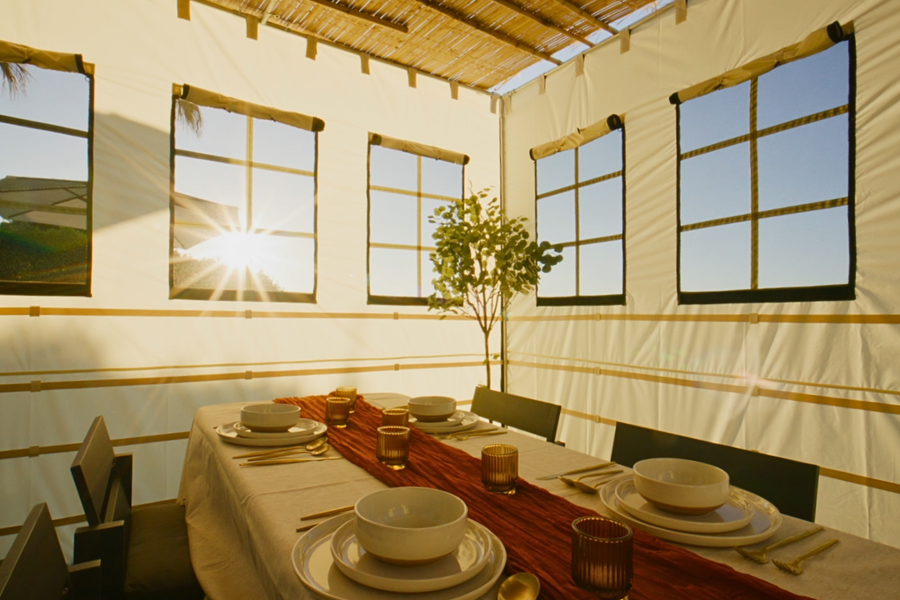
If there's one item that's caused more confusion than almost anything else in modern Sukkah building, it's the bamboo Schach mat.
After all, bamboo grows from the ground.
Problem solved...
...except not always.
The first question isn't what it's made of.
It's what it was made for.
If a woven mat was manufactured to be sat on, slept on, or used as flooring, it generally isn't suitable as Schach because it has become a functional object rather than simple roofing material (Shulchan Aruch, Orach Chaim 629).
But mats produced specifically for use as Schach are a different story.
Then another wrinkle appears.
What is holding the mat together?
Some halachic authorities, including Rav Moshe Feinstein, ruled that mats bound together with woven materials that are themselves capable of becoming ritually impure can create significant halachic concerns, while monofilament fishing line does not present the same issue because it simply binds the slats together rather than becoming part of a woven fabric (Igros Moshe, O.C. 1:177).
In other words:
It's possible for two bamboo mats to look almost identical...
...while only one is suitable for your Sukkah.
This is one of the biggest reasons people buy certified Schach mats rather than trying to improvise.
Can You Tie Your Schach Down?
If you've ever built a Sukkah somewhere windy, this question arrives remarkably quickly.
"So...can I just tie everything down?"
Yes.
And no.
Here's the distinction.
If the Schach would blow away during an ordinary wind ("ruach metzuyah"), that's already a construction problem.
Using string or wire to hold down otherwise unstable Schach doesn't solve that issue.
Instead, the Schach should first be secured using kosher materials – such as wooden beams resting across the top.
Once it's already secure enough to withstand a normal breeze, additional ties may be used simply to protect it from unusually strong winds ("ruach she'einah metzuyah") (Rama O.C. 629:7).
Think of it this way.
The rope shouldn't be doing the actual job of holding your roof on.
It's just the insurance policy.
The Schach Board Width Rule Most People Never Hear About
Not every piece of wood automatically qualifies.
Boards wider than four tefachim (roughly 12–14 inches, depending on the halachic measurement used) generally aren't used because they resemble permanent roofing, which undermines the temporary nature of the Sukkah.
Even turning the board on its side doesn't fix the problem.
Many communities are also careful to avoid finished construction lumber altogether, even when technically narrower, because it looks too much like an ordinary ceiling (Shulchan Aruch, Orach Chaim 629).
Sometimes appearances matter.
How Much Schach Is Enough?
This is where many first-time builders overthink things.
The requirement isn't mathematical perfection.
The basic rule is that there should be more shade than sunlight inside the Sukkah.
If the sun outnumbers the shadows, you need more Schach.
On the other hand...
If you've built such a dense roof that rain can't realistically get through at all, you've probably gone too far.
The ideal Schach creates comfortable shade while still looking and functioning like temporary roofing.
It's one of those rare building projects where "somewhere in the middle" is actually the official answer.
Common Schach Mistakes (And How to Avoid Them)
Before calling the Sukkah finished, it's worth running through a quick mental checklist.
✔ Use materials that grew from the ground.
✔ Make sure they're detached before placing them on the Sukkah.
✔ Avoid items that function as utensils or containers.
✔ Buy Schach mats from reliable sources rather than assuming all bamboo mats are identical.
✔ Ensure your Schach can stand up to an ordinary breeze without relying on string to do all the work.
✔ Aim for more shade than sun – but don't build yourself a waterproof gazebo.
None of these rules are especially difficult once you know they're there.
The trick is simply knowing they're there.
The Bottom Line
At first glance, Schach seems like the easiest part of building a Sukkah.
After all, it's just "putting branches on the roof."
In reality, it's the part with the most fascinating details.
The Torah doesn't just ask for any roof.
It asks for a roof that reminds us where our protection ultimately comes from – not permanent construction, expensive materials, or architectural brilliance, but trust in Hashem while dwelling beneath something intentionally temporary.
Which is why Judaism spends so much time talking about bamboo mats, bundles of reeds, wooden slats, fishing line, and roofing boards.