




Table of contents
Kiddush, Nightfall, and the Blessing That Refuses to Sit Still
If Sukkot had a personality, it would be that friend who says, “Relax! Enjoy the moment!” – and then quietly hands you a dense stack of halachic footnotes.
Because while Sukkot is all about joy, fresh air, and leafy roofs, it also raises some of Judaism’s most timing-sensitive questions. When exactly does night begin? Can you make Kiddush early? What if you never left the Sukkah? And why does one blessing (leishev baSukkah) manage to cause so much stress?
Let’s take a walk through two deceptively simple questions that open up a surprisingly rich discussion about time, doubt, and how Jewish law thinks about continuity.
First Things First: What’s the Rush to Make Kiddush?
On most holidays, Kiddush – the sanctification of the day over wine – can be made a bit early. Accept the holiday, say Kiddush, eat dinner, enjoy.
But on the first night of Sukkot, Ashkenazi custom insists on waiting until tzeit hakochavim – nightfall, when stars are visible – before making Kiddush (Rema, Orach Chayyim 639:3).
Why? Because of a blessing that doesn’t like ambiguity.
Meet the Trouble-Maker: Leishev BaSukkah
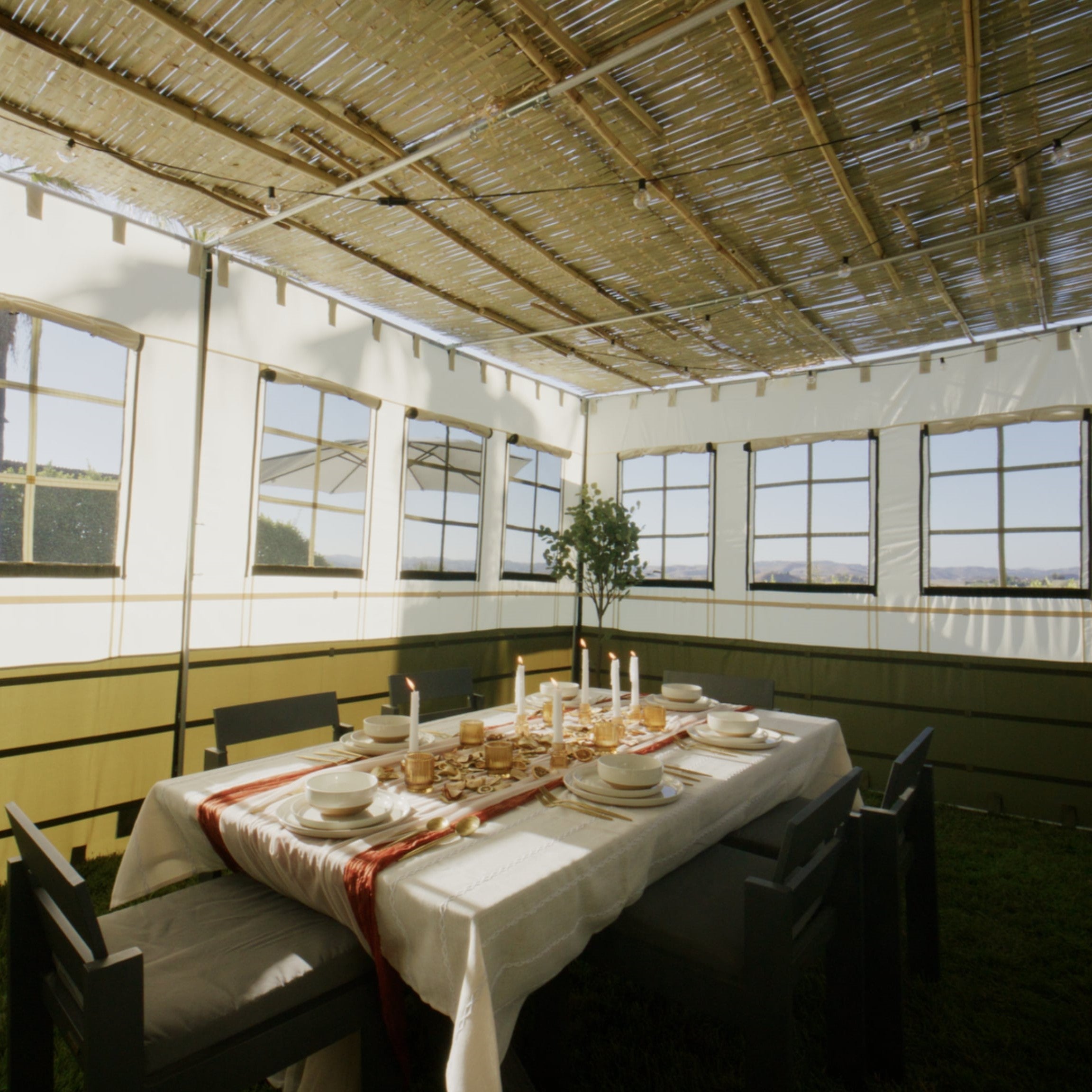
Leishev baSukkah means “to dwell in the Sukkah.” It’s the blessing said when one eats a significant meal in the Sukkah.
Here’s the catch: according to many authorities, this blessing can only be said when it’s definitely night on the first evening of Sukkot. Accepting the holiday early (tosefet yom tov) might work for Kiddush – but may not be enough to create the full halachic “reality” needed to say leishev baSukkah (Magen Avraham; Biur Halacha).
Why does this matter? Because on the first night of Sukkot, eating bread in the Sukkah isn’t just a nice custom – it’s a Torah-level obligation, learned from a textual comparison (gezerah shavah) between Sukkot and Passover (Talmud Sukkah 27a).
So the logic goes like this:
You must eat bread in the Sukkah on the first night.
That mitzvah is tied to nighttime.
The blessing that accompanies it can’t be said until it’s unquestionably night.
Hence the collective Jewish habit of staring at the clock and muttering, “Is it tzeit yet?”
But What If the Problem Goes Away?
Here’s where things get interesting.
What if someone isn’t obligated to eat in the Sukkah at all? For example:
A woman, who is generally exempt from time-bound positive commandments.
Someone who, due to danger or severe weather, genuinely can’t be in the Sukkah.
In those cases, does the whole “wait until nightfall” rule still apply?
Many authorities say no.
If there’s no obligation to eat in the Sukkah – and therefore no leishev baSukkah blessing in play – then Kiddush itself doesn’t need to wait for full nightfall. It can be made earlier, like on other holidays, because Kiddush stands on its own (Shavuot 20a; Kiddushin 29a).
In other words: if the Sukkah isn’t halachically relevant to you right now, it doesn’t get to boss your schedule around.
What About Emergencies (or Hurricanes)?
Jewish law has an answer for that too – because of course it does.
If going into the Sukkah later at night would be dangerous (pikuach nefesh, a life-threatening situation), then one should do whatever mitzvah is safely possible earlier, even during bein hashmashot – the twilight period between sunset and nightfall, which is halachically uncertain (Biur Halacha, O.C. 261:2).
In such a case, eating a minimal amount (kezayit, roughly an olive-sized portion) of bread in the Sukkah before conditions worsen may count as fulfilling a Torah obligation under uncertainty. Blessings, however, are omitted, because when there’s doubt, Jewish law prefers caution (safek berachot lehakel) (Ran, cited in Beit Yosef O.C. 665).
Translation: do the mitzvah if you can, skip the blessing, and don’t argue with the weather.
So What’s the Big Picture?
Sukkot is a holiday that lives in tension:
Fixed calendar vs. lived experience
Clear obligations vs. real-world messiness
Joy vs. hyper-precise timing
The halachic system responds not with rigidity, but with layers: obligations when they matter, flexibility when they don’t, and a strong preference for avoiding unnecessary blessings.
Whether it’s waiting for nightfall or making Kiddush early, the underlying principle remains the same: mitzvot are meant to be lived, not micromanaged into misery.
And if Sukkot teaches anything, it’s that sometimes the holiest thing you can do is pause, look at the sky, and ask – is it really night yet?
The Takeaway: Judaism Anticipates Real Life – But Not Gymnastics
These car-Sukkah discussions aren’t jokes or stunts. They’re sincere attempts to balance real-world movement with serious mitzvah observance. They show how deeply Jewish law engages with lived reality – cars, roads, schedules, and all.
But they also reveal something else:
Judaism is remarkably accommodating – without encouraging acrobatics.
If someone truly needs to be on the road during Chol HaMoed, the law makes room for that. If someone is home, a backyard Sukkah beats a Subaru every time.
And if someone finds themselves measuring a sunroof with a ruler on Chol HaMoed?
At least they can say they really thought it through.