







Table of contents
What qualifies as a “home” in Jewish law – and when mezuzah becomes mandatory
If there’s one thing halacha loves, it’s categories. Permanent vs temporary. Obligated vs exempt. “This counts” vs “nice try.”
And nowhere does that tension show up more clearly than in two deceptively simple questions:
Does a Sukkah need a mezuzah?
And when exactly does a home become…mezuzah-worthy?
Spoiler: the answer to both revolves around one idea – dirat keva vs dirat arai. Or in plain English: permanent dwelling vs temporary setup.
Let’s unpack.
The Mezuzah Rule: Not Every Door Gets One
A mezuzah – that small parchment scroll affixed to a doorpost – isn’t just décor with good intentions. It’s a mitzvah (commandment), but it only applies when certain criteria are met.
One of the biggest:
The space has to qualify as a dwelling.
More specifically, a dirat keva – a permanent residence.
So if something is considered temporary? It’s usually out.
The Sukkah Problem: Is The Sukkah A Home?
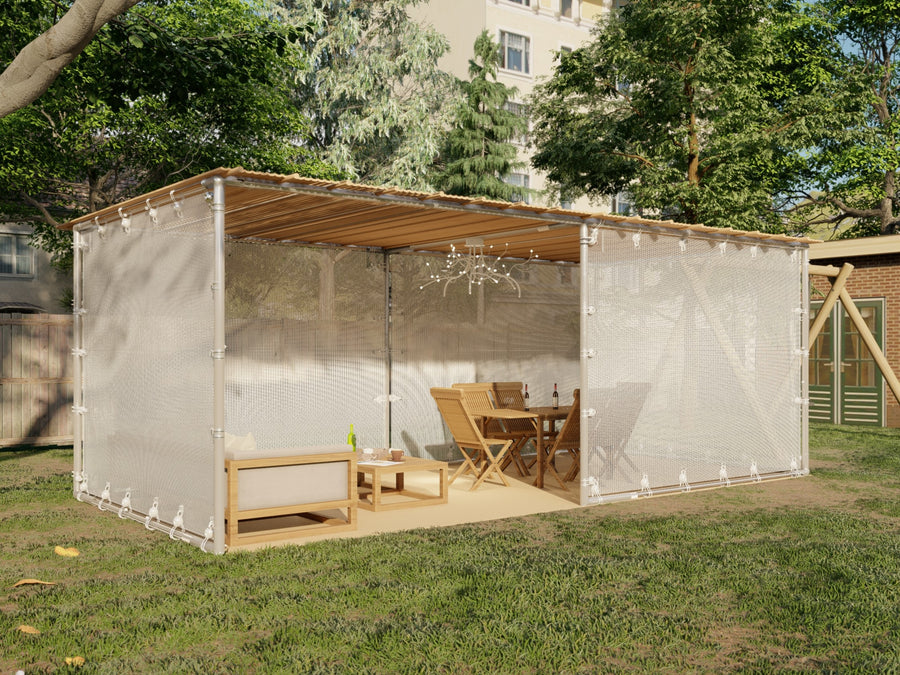
A Sukkah is meant to be lived in – eating, sleeping, lounging, the whole “move your life outdoors” experience.
So logically, it sounds like it should need a mezuzah.
But halacha says: no mezuzah required.
Why?
Because a Sukkah is defined as a dirat arai – a temporary dwelling.
Even if you’re fully committed to your Sukkah life (sleeping there, working there, maybe even considering a Zillow listing), the halachic definition doesn’t budge. It’s built to be temporary, used for a limited time, and then taken down. That’s the category it lives in.
This isn’t just a modern interpretation – it’s rooted in a classic debate in the Talmud (Yoma 10), where the majority opinion rules that a Sukkah is exempt from mezuzah for exactly this reason [Talmud Yoma 10; Shulchan Aruch Yoreh Deah 286:11].
But What If Someone Really Commits?
Let’s say someone decides:
“This isn’t a holiday hut. This is my new lifestyle.”
Lives in the Sukkah full-time. Eats there. Sleeps there. Cancels their lease. Tells friends to forward their mail.
Does it now need a mezuzah?
Not so fast.
Even then, many authorities maintain that during the festival of Sukkot, the structure is still halachically defined as temporary – because that’s the purpose it was built for.
However, there’s nuance.
If a Sukkah is constructed inside a space that’s already a permanent room (like converting a room into a Sukkah), some opinions say the obligation of mezuzah remains because the underlying structure is permanent [Arukh HaShulchan YD 286:27].
Others argue that once it’s functioning as a Sukkah during the holiday, its temporary status overrides everything [Mishna Berura 626:21].
Translation: even when you think you’ve found a loophole, halacha has already debated it.
The One Door That Definitely Counts
There is one place everyone agrees on:
If there’s a doorway between a house and a Sukkah, the house side still requires a mezuzah.
Because the house? Very much still permanent.
No identity crisis there.
Do Parents Need to Provide a Sukkah for Their Kids?
Now for a curveball question.
A parent is obligated to:
Provide for young children
Educate them in mitzvot (chinuch – training children in religious practice)
But what about grown-up children still living at home?
Is there an obligation to provide them with a Sukkah?
The answer leans less on Sukkah laws – and more on something else entirely: tzedakah (charity).
The Tzedakah Angle
Halacha recognizes an obligation to support family members who are not financially independent.
So if adult children:
Still rely on their parent
And the parent is able to provide
Then supporting them – including helping them fulfill basic needs – can fall under tzedakah obligations [Shulchan Aruch YD 251:3–4].
But – and this is key – that doesn’t necessarily mean a parent must personally provide every mitzvah item.
If there’s already a Sukkah available, adult children can use it – even without explicit permission – and fulfill their obligation.
In other words:
There’s a responsibility to support
But not necessarily to custom-build mitzvah infrastructure for each child
The Big Picture: Halacha Loves Definitions
Across all these cases, one theme keeps showing up:
Halacha isn’t just asking what are you doing?
It’s asking what category does this fall into?
Sukkah → temporary → no mezuzah
Adult children → independent (sort of) → support depends on context
It’s less about emotion, more about classification.
The Bottom Line
This isn’t just about mezuzahs and Sukkahs. It’s about how halacha draws lines:
Not every “home” is halachically a home, and
And not every intuitive answer holds up under scrutiny
Which is why, somewhere between a backyard Sukkah and a house, halacha quietly asks:
Is this really where you live – or just where you’re staying for now?