




Table of contents
First: What Does Halacha Actually Require? The Wall Minimum: Two and a Bit The “Lavud” Trick: When Gaps Don’t Count What About Wind? The DIY Portable: Engineering Meets Halacha The Reality Check: Assembly Required Enter the Pop-Up Travel Sukkah Halachic Considerations: Is Pop-Up Kosher? The Emotional Factor: Sukkah Without the Schlep So…Which One Wins? Choose DIY If: Choose Pop-Up If: The Bigger Picture: A Portable Reminder Final Thoughts
What’s the ultimate portable Sukkah? DIY PVC pipes…or pop-up and go?
Every year, without fail, someone looks at a picnic table in a park and thinks:
“You know what this needs? A Sukkah.”
Not a sprawling, wood-paneled backyard masterpiece. Not a prefab palace with bamboo trim. Just something simple. Portable. Kosher. Wind-resistant. And ideally light enough to fit in the back of a minivan next to the folding chairs and the kugel.
So what’s the ultimate portable Sukkah?
Is it a clever DIY halachic hack involving PVC pipes and string?
Or is it a modern pop-up model that unfolds faster than you can say Chol Hamoed?
Let’s break it down.
First: What Does Halacha Actually Require?
Before anyone starts sawing PVC or clicking “Add to Cart,” it helps to know what a Sukkah technically needs.
The Wall Minimum: Two and a Bit
Halachically, a Sukkah requires three walls – but not quite the way most people think.
The Shulchan Aruch (Orach Chaim 630:2–5) explains that you actually need two full walls plus a third wall that is at least one tefach wide (a tefach is roughly 3–4 inches, depending on measurements) [Shulchan Aruch OC 630:2–5].
That’s it. Two-and-a-half walls.
Already this is sounding promising for anyone trying to build something portable.
The “Lavud” Trick: When Gaps Don’t Count
Here’s where things get interesting – and surprisingly practical.
There’s a halachic concept called lavud. Lavud means that if gaps in a wall are less than three tefachim (approximately 9–12 inches), we treat the gaps as if they’re closed [Shulchan Aruch OC 630:9].
In other words: if you stretch string horizontally around a frame, as long as each row of string is within three tefachim of the next, halacha considers it a solid wall.
Yes. String counts.
Even better: the wall must reach a minimum height of ten tefachim (around 40 inches) [Shulchan Aruch OC 630:9]. Once you reach that height, you’re good. The Schach (the natural roofing material) does not need to rest directly on the wall – it can be supported above it [Shulchan Aruch OC 630:9].
Minimalist? Absolutely.
Halachically sound? Also yes.
What About Wind?
Walls can technically be made from almost anything. The Shulchan Aruch permits using trees as walls – as long as they don’t sway in a typical wind, or they are secured properly [Shulchan Aruch OC 630:10].
That “ordinary wind” requirement matters.
Flimsy sheets flapping like dramatic stage curtains? Not ideal.
PVC frame with tightly wrapped string or stable fabric panels? Much better.
Also worth noting: the Rema adds that walls shouldn’t be made of materials that emit a foul odor [Rema OC 630:1]. So maybe skip the compost tarp.
The DIY Portable: Engineering Meets Halacha
Now imagine this scenario:
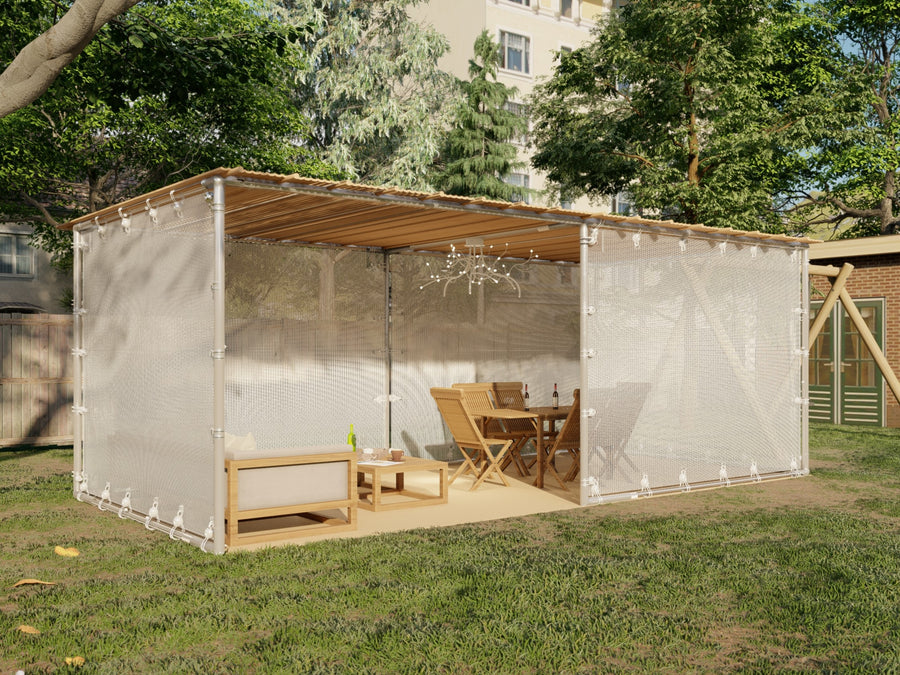
A modest 4x6 foot frame. Maybe 5 feet tall – tall enough to sit and move around, even if nobody’s planning on hosting Simchat Beit HaShoeva inside it.
The structure?
PVC pipes.
Why PVC?
Lightweight
Cheap
Easy to cut into 2–3 foot segments
Fits in the trunk of a sedan
Assembles with connectors in minutes
Add horizontal strings wrapped around three sides at intervals of less than three tefachim. Make sure you reach ten tefachim high. Lay a kosher Schach mat on top.
Done.
Portable – achieved.
It’s halachically creative without being halachically reckless. It uses lavud properly. It satisfies the wall requirements. It’s stable if assembled well.
But there’s a catch.
The Reality Check: Assembly Required
Thirty PVC pieces plus connectors might not sound like much – until you’re crouching in a park with kids asking when the snacks are coming.
Yes, it fits in the car.
Yes, it’s inexpensive.
Yes, it earns serious halachic-geek points.
But it also requires:
Measuring
Cutting
Assembly
Disassembly
Keeping track of connectors
Remembering which piece goes where
And if you’ve ever tried to reassemble something without the instructions, you already know how that story ends.
DIY saves money.
It does not save effort.
Enter the Pop-Up Travel Sukkah
Now let’s look at the modern alternative.
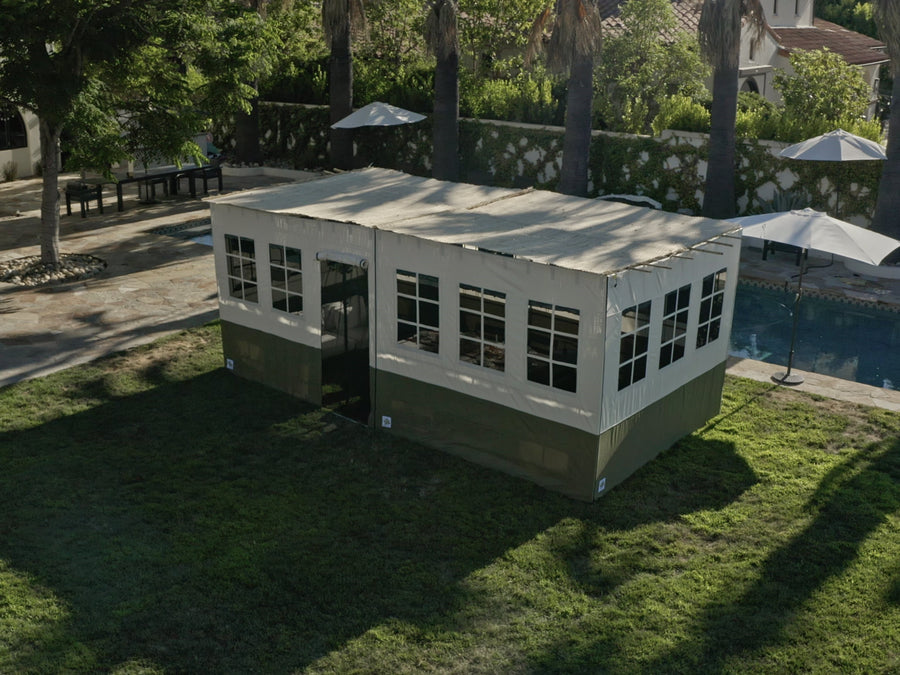
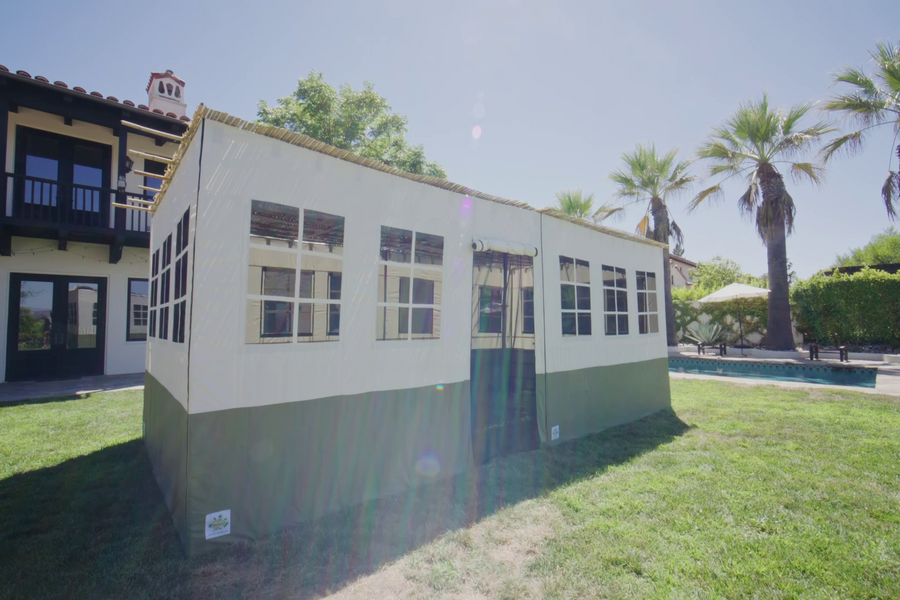
A pop-up travel Sukkah unfolds in seconds. No tools. No measuring tape. No lavud calculations in the middle of the park.
The entire structure collapses into a carry bag.
Lightweight enough for kids to carry.
Sturdy enough to handle normal wind.
Reinforced walls.
Ground pegs for stability.
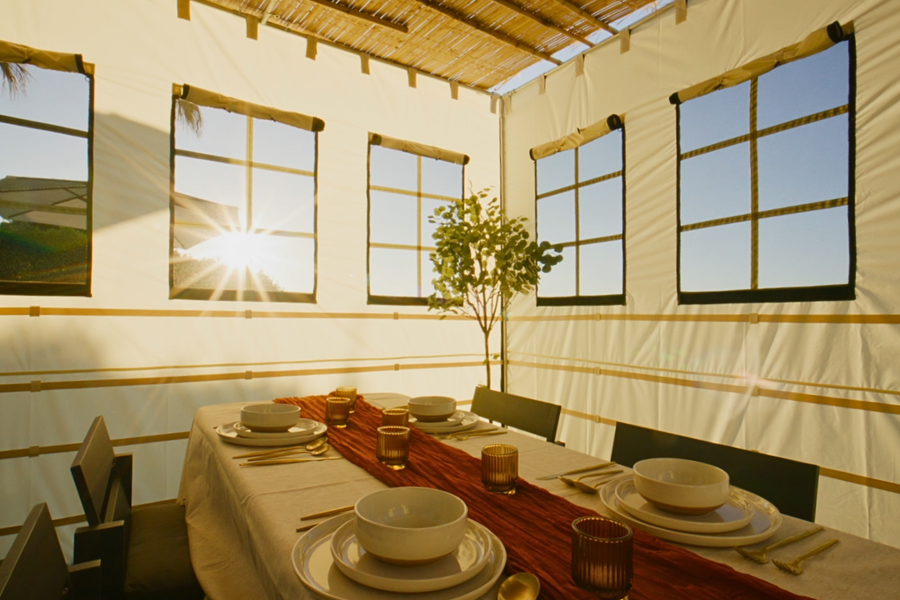
Windows on all four sides for airflow.
And it comes with a kosher l’Mehadrin Schach mat (meaning it meets higher halachic standards regarding Schach materials).
For someone hopping between family visits, Chol Hamoed outings, or even flights, that portability isn’t just convenient – it’s transformative.
Halachic Considerations: Is Pop-Up Kosher?
A valid – must meet three key requirements:
Proper walls (minimum configuration as discussed above)
Kosher Schach (natural material, detached from the ground, not susceptible to impurity)
Stability in ordinary wind
Modern pop-up models address these concerns directly:
Reinforced frames prevent sway.
Poles support the Schach properly.
Ground pegs add wind resistance.
Schach mats are specifically designed for kosher use.
As long as the structure is stable under normal wind conditions (a halachic requirement derived from OC 630:10), it can absolutely qualify.
And unlike string walls, no one needs to explain lavud to confused cousins mid-meal.
The Emotional Factor: Sukkah Without the Schlep
Let’s be honest.
The mitzvah of Sukkah is about joy. It’s about dwelling in a temporary structure that reminds us of divine protection in the wilderness.
It’s not about arguing with PVC joints.
There’s something beautiful about building your own Sukkah from scratch. It connects you to the halacha in a tactile way. It forces you to understand tefachim and lavud. It transforms abstract law into physical reality.
But there’s also something beautiful about spontaneity.
Packing a Sukkah in the trunk.
Driving to the park.
Popping it open (being careful your spot doesn’t invalidate your Sukkah).
Eating your kugel.
Packing it up again.
No heavy beams. No drill bits. No existential framing questions.
Just mitzvah-on-demand.
So…Which One Wins?
It depends what you’re optimizing for.
Choose DIY If:
You love halachic engineering
You enjoy building things
Budget is the main factor
You don’t mind assembly time
You like telling people about lavud
Choose Pop-Up If:
You want zero hassle
You travel frequently
You value speed
You prefer reinforced walls over creative string geometry
You want the kids carrying the Sukkah instead of watching you build it
Both approaches can be halachically valid.
Both can transform a picnic table into holy space.
One leans toward ingenuity and elbow grease.
The other leans toward convenience and portability.
The Bigger Picture: A Portable Reminder
At its core, a portable Sukkah embodies the essence of Sukkot.
Temporary.
Mobile.
Dependent on structure – but not permanence.
Whether it’s PVC and string carefully spaced under three tefachim apart, or a reinforced pop-up model with ready-to-go Schach, the goal is the same:
To sit.
To eat.
To dwell – even briefly – in a space that reminds us that protection doesn’t come from walls alone.
And maybe to enjoy some pie.
(Other than more pie, what more could anyone ask for?)
Final Thoughts
In the end, the “ultimate portable Sukkah” isn’t defined by how it’s built.
It’s defined by whether it gets used.
If it makes it to the park.
If it makes it on the trip.
If it makes Chol Hamoed feel just a little more elevated.
Because the best portable Sukkah – pop-up or pipe-built – is the one that turns wherever you are into somewhere holy.