





Table of contents
First Things First: What Makes a Sukkah a Sukkah? 1. Walls 2. Schach The Three-Sided Pyramid Question Do the Walls Need to Be Straight? How Big Does the Roof Need to Be? Does a Sukkah Have to Be Square? The Famous 7×7 Rule The Circular Sukkah Enter the Pentagonal Sukkah What This Teaches About Halachah So…Can You Build a Pyramid Sukkah?
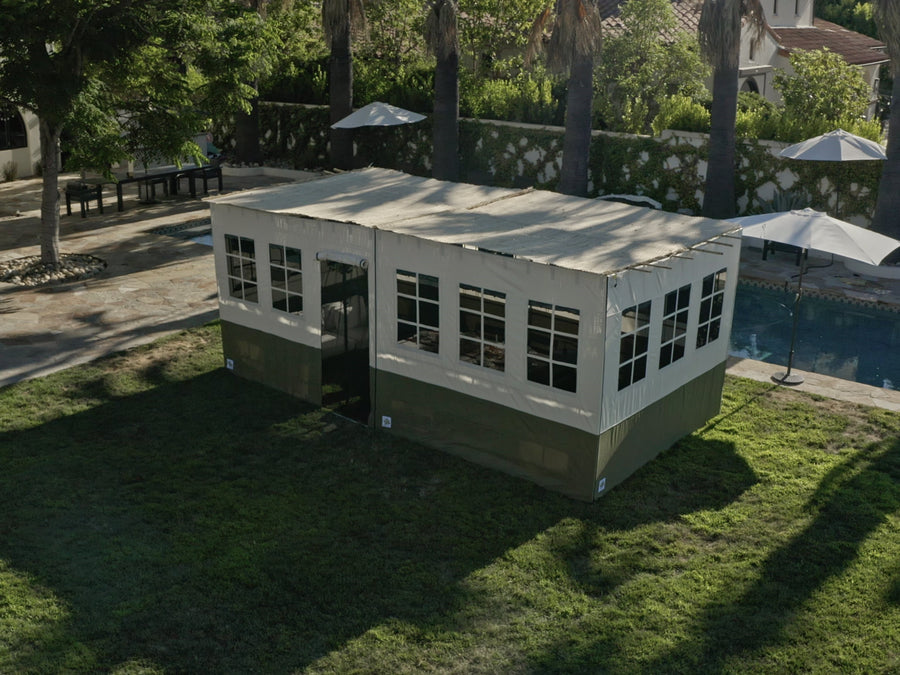
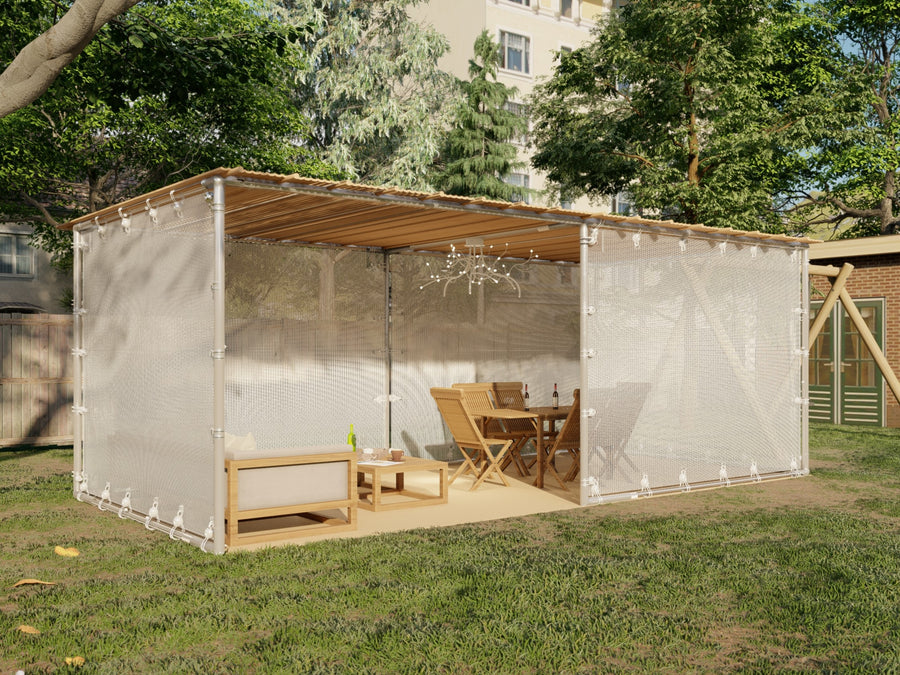
When most people picture a Sukkah, they imagine something fairly straightforward: a small hut with four walls and a leafy roof made from branches. Maybe a few hanging decorations, a plastic tablecloth, and a questionable folding chair or two.
But Jewish law has a way of inviting deeper questions.
What if the Sukkah isn’t square?
What if it’s round?
Or pentagonal?
Or – because someone somewhere will inevitably try this – a three-sided pyramid?
Welcome to one of the more delightful intersections of Talmudic law and geometry.
It turns out the rabbis thought about these questions too.
First Things First: What Makes a Sukkah a Sukkah?
Before getting creative with architectural experiments, it helps to review the basics.
A Sukkah is the temporary dwelling Jews use during the festival of Sukkot, fulfilling the commandment:
“You shall dwell in Sukkot for seven days.” (Leviticus 23:42)
The Talmud describes several structural requirements, but two of the most important are:
1. Walls
A Sukkah must have at least 2.5 walls.
The Talmud derives this from scriptural interpretation and states that a Sukkah requires a minimum of two full walls and a partial third wall [Sukkah 6b].
2. Schach
The roof covering – called Schach – must be made from natural materials that grew from the ground but are no longer attached to it, such as branches, bamboo, or reeds.
Schach is actually the defining element of the structure. In fact, many commentators note that the word “Sukkah” itself refers primarily to the roof covering rather than the walls [Rashi on Sukkah 2b].
The roof must provide more shade than sunlight, but still allow the stars to be visible at night.
Simple enough.
But once those basic requirements are met, things can get surprisingly creative.
The Three-Sided Pyramid Question
Consider the following architectural thought experiment.
Someone decides to build a Sukkah shaped like a three-sided pyramid.
Imagine three slanted walls leaning inward toward the top. Instead of meeting at a single point, however, they stop just short – leaving a small triangular opening where Schach is placed.
The structure technically has three walls and a roof made of Schach.
But is it actually a valid Sukkah?
Two main issues arise.
Do the Walls Need to Be Straight?
The first question is whether Sukkah walls must be vertical.
Jewish law contains a fascinating concept called dofen akumah, which literally means “a bent wall.”
This principle appears in the Talmud when discussing situations where invalid roofing material separates the wall from the kosher Schach [Sukkah 17a].
Ordinarily, the Schach must begin close to the walls – within three tefachim (handbreadths).
But if non-kosher roofing sits between the wall and the Schach, the Talmud treats that roofing as if it were simply an extension of the wall that bends inward.
In other words, the wall is imagined as traveling upward and then horizontally until it reaches the Schach.
This legal fiction allows the Sukkah to remain valid – provided that people sit under the actual Schach rather than under the “bent wall.”
And that idea becomes very helpful when thinking about unusual structures like pyramids.
Even if some of the slanted surfaces function halachically as “walls,” the Sukkah could still be valid so long as the seating area lies beneath the kosher Schach.
How Big Does the Roof Need to Be?
The second problem with the pyramid design concerns the size of the Schach area.
Suppose the opening at the top of the pyramid is extremely small – say, only nine square inches.
Would that still count?
To answer this question, the Talmud introduces another key rule.
A Sukkah must be large enough to hold a person’s head and most of their body [Sukkah 2b].
Later rabbinic tradition standardizes this as a minimum space of seven by seven tefachim.
A tefach is a halachic unit roughly equal to a handbreadth (approximately 3–4 inches, depending on the opinion).
So a valid Sukkah must contain a floor space of at least 7×7 tefachim.
Since the Schach defines the Sukkah, many commentators conclude that the area directly beneath the Schach must meet that minimum size as well.
That means a tiny patch of Schach at the tip of a pyramid would likely be too small.
Unless, of course, the pyramid is large enough that a 7×7 tefach area under the Schach exists somewhere inside.
Which leads to an even broader question:
Does a Sukkah Have to Be Square?
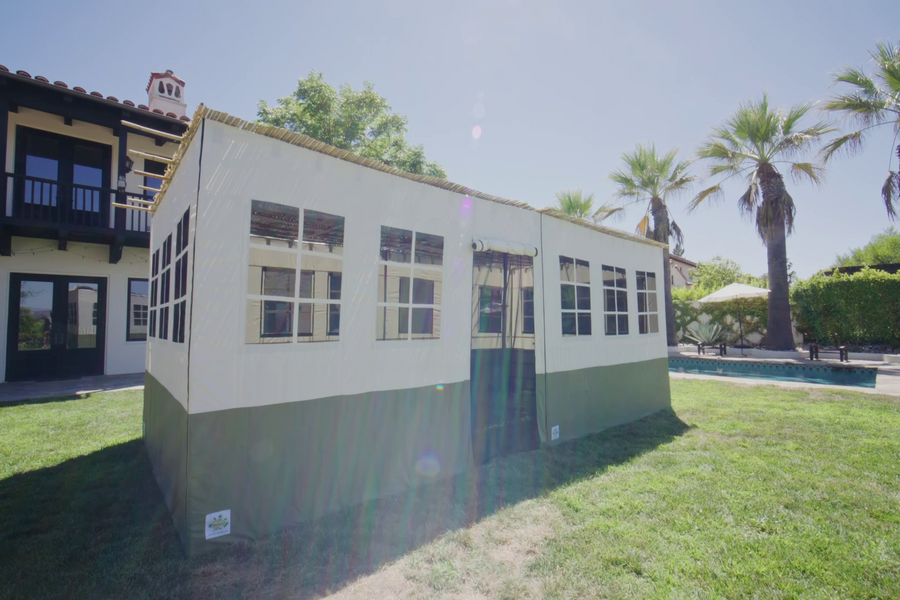
Most Sukkot are rectangular simply because it’s easy.
But Jewish law doesn’t actually require that shape.
A Sukkah could theoretically be:
Triangular
Circular
Pentagonal
Hexagonal
Or something that would make a geometry teacher very proud.
The real requirement is not the shape itself – but what the shape contains.
The Famous 7×7 Rule
The Shulchan Aruch, the major code of Jewish law, addresses the issue directly:
If a Sukkah is round, it must contain within it a square measuring seven by seven tefachim.
– Shulchan Aruch, Orach Chaim 634:2
In other words, the Sukkah’s shape doesn’t matter.
What matters is that somewhere inside the structure there is room for a 7×7 square.
The Mishnah Berurah, a classic commentary on the Shulchan Aruch, explains that this rule applies not only to circular Sukkot but to any unusual shape.
Even if the Sukkah is triangular, oval, or oddly shaped, it remains valid as long as that minimal square could theoretically fit inside.
Interestingly, the person sitting inside the Sukkah does not need to sit inside that square – the square simply needs to exist as potential space.
The Circular Sukkah
This rule becomes especially interesting when applied to a round Sukkah.
How big must the walls be?
If a square measuring 7×7 tefachim must fit inside the circle, geometry tells us the circle must have a certain minimum circumference.
Some traditional calculations estimate the necessary circumference as 29.4 tefachim, using the classic rabbinic approximation that π equals 3.
This type of calculation actually appears in the Talmud’s discussion of circular Sukkot [Sukkah 7b–8b].
So yes, if someone wants to build a perfectly circular Sukkah, Jewish law has already done the math.
Enter the Pentagonal Sukkah
Once mathematicians get involved, things get even more interesting.
Suppose someone builds a five-sided Sukkah – a pentagon.
How long must each wall be to ensure the Sukkah contains that critical 7×7 square?
The answer depends on the exact geometry of the shape.
For a regular pentagon, calculations show that each side would need to measure slightly more than 6.3 tefachim.
Increase the number of sides and the required wall length shrinks.
For example:
Hexagon: about 5.5 tefachim per side
Heptagon: about 4.6 tefachim per side
As the number of sides increases, the shape begins to approximate a circle, and the wall lengths adjust accordingly.
In the limit – when the number of sides becomes infinite – you essentially have a round Sukkah again.
Which brings the whole discussion full circle.
Literally.
What This Teaches About Halachah
At first glance, these discussions might seem overly technical.
After all, how many people are actually building pentagonal Sukkot?
But the deeper point is something the Talmud does remarkably well: it explores the underlying principles behind a mitzvah.
The question isn’t just what shape a Sukkah should be.
The question is what makes a Sukkah function as a Sukkah.
Is it the walls?
The roof?
The space inside?
The answer turns out to be a combination of all three – but centered around a single idea:
A Sukkah must create a space suitable for dwelling, even if only temporarily.
As long as that minimal living space exists beneath the Schach, the exact geometry becomes surprisingly flexible.
So…Can You Build a Pyramid Sukkah?
In theory, yes.
As long as the structure satisfies three main requirements:
At least 2.5 valid walls [Sukkah 6b]
Kosher Schach covering the dwelling area [Sukkah 2b]
Enough interior space to contain a 7×7 tefach square [Shulchan Aruch O.C. 634:2]
If those conditions are met, the Sukkah can take on almost any shape.
Square.
Round.
Pentagonal.
Or perhaps a slightly unconventional pyramid.
Of course, most people will probably stick with the classic backyard box.
But it’s comforting to know that if someone decides to turn Sukkot into a geometry project, the Talmud has already thought several steps ahead.