




Table of contents
Meet the Sukkah-Inventor: Canvas, Metal, and a Dream The Halachic Heart of the Matter: Walls, Doors, and Boundaries But…How Far Can You Go? Engineering Tips: How to Expand Without Lifting Off Like a Kite Pro Tip: Buy Extra Poles & Canvas Or… Just Buy a Kit That Grows With You Summary: Can You Do It? Yes. Should You? It Depends. Final Thoughts: The Joy of DIY Sukkah-ing
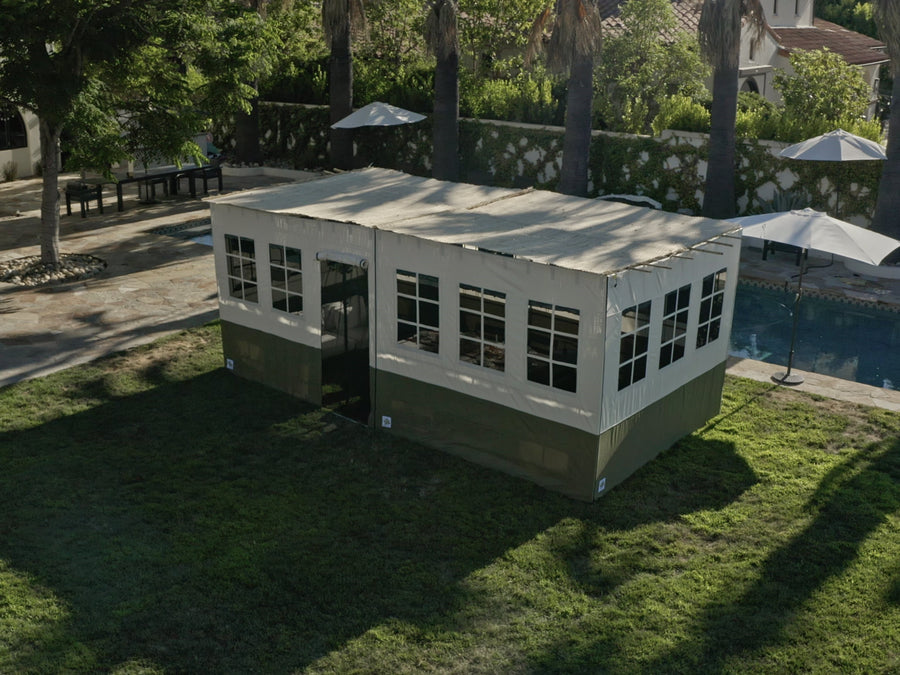
So, you’ve got a canvas Sukkah.
It’s compact, it’s cozy, it fits perfectly in that corner of your backyard… until you invite Bubbe, your neighbor’s family of seven, and your cousin who suddenly got very interested in the mitzvah of Sukkah this year.
Now you’re standing there, scratching your head, wondering:
“Could I just… expand it?”
That’s exactly the question creative souls have been asking since canvas Sukkahs first came about. So, let’s dive into the answer, blending halachic nuance, engineering curiosity, and some good old-fashioned Sukkot spirit.
Meet the Sukkah-Inventor: Canvas, Metal, and a Dream
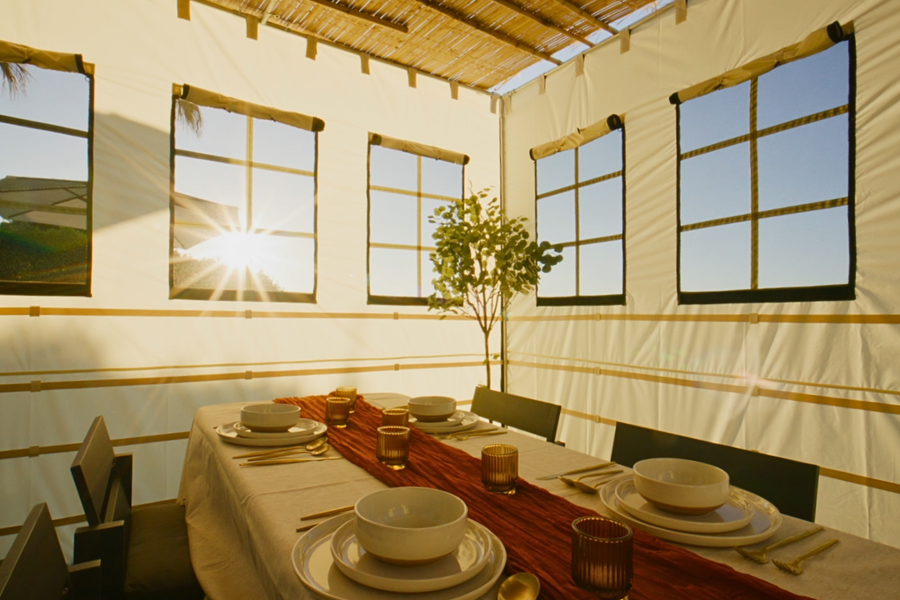
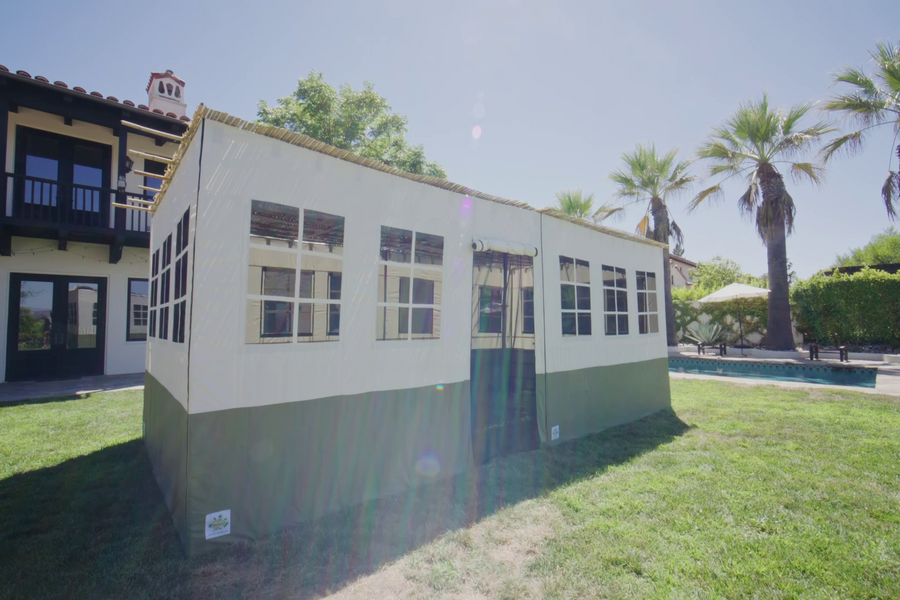
First, let’s describe the classic canvas Sukkah setup: The Sukkah is made of canvas, which is wrapped around a metal frame.
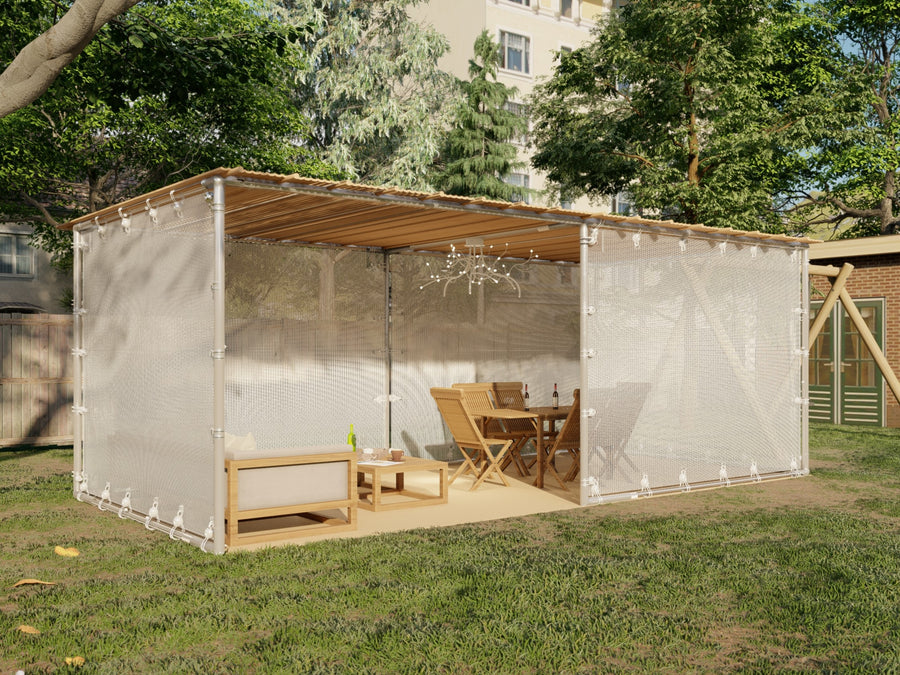
The savvy builder may be wondering – what if I just expanded it? What if I didn’t wrap one side all the way around, and instead extended it outward with posts to support the Schach (roof covering of branches)?
Cue rough sketches (don’t worry, we’ve all been there). The basic idea: unwrap one side, add posts and beams, extend your Schach overhead (often kosher bamboo Schach mats) – essentially creating a larger dining space without building a whole new structure.
This also raises two practical concerns:
Wind: Would the loosened canvas act like a sail and topple the Sukkah?
Halachah (Jewish law): Would this still count as a kosher Sukkah if part of the space had no solid wall – only a framework of posts and beams?
The Halachic Heart of the Matter: Walls, Doors, and Boundaries
First, let’s zoom in on the halachic question. The Torah tells us:
“You shall dwell in booths for seven days.” (Leviticus 23:42)
The Talmud, in Tractate Sukkah 6b, elaborates that a kosher Sukkah needs at least two full walls and part of a third wall. The ideal is four walls, but two-plus-a-bit is the minimum.
Now, what if your ‘walls’ aren’t solid, but rather posts with a crossbeam overhead – essentially forming a Tzurat HaPetach, or "form of a doorway"? This is a well-known halachic device used in eruvin (boundaries allowing carrying on Shabbat), and sometimes in Sukkot construction as well.
Chayei Adam (145:3) – a classic halachic work by Rabbi Avraham Danzig – specifically discusses this:
“If one has two complete walls forming a corner, and the third side is merely a Tzurat HaPetach – even if the opening is wide – this is sufficient for the Sukkah to be valid.”
In other words: YES – a doorway frame can count as a wall for Sukkah purposes.
But…How Far Can You Go?
Here’s where things get juicy, with two critical questions:
How far can I extend that third wall without a solid wall there?
Could I essentially extend the Schach indefinitely, as long as there’s a Tzurat HaPetach?”
Can you just extend it forever without even a Tzurat HaPetach, because there doesn’t seem to be a limit?
Of course, caution is needed – halachic sources generally assume your sitting/dining area remains “within” the main Sukkah space, not hanging out in a vast unbounded patio with some bamboo overhead.
That said, if your extended section still has the required minimum walls (even via doorway-frames), and your Schach meets kosher criteria (detached from the ground, made of natural materials, giving more shade than sun)…then many poskim (halachic authorities) would permit a reasonable expansion.
The key is ensuring that your main seating area still feels like part of the Sukkah proper – not just under a pergola.
Engineering Tips: How to Expand Without Lifting Off Like a Kite
Of course, even if the rabbis say “yes” – the wind might say “no.”
Loosening the canvas might turn it into a giant sail. While the frame is heavy and the canvas durable, gusty weather could be a real issue.
Solution #1: Tension & Anchoring
Keep the remaining canvas walls tightly secured to the frame. Use extra guy lines, ground stakes, or even weights to prevent swaying.
Solution #2: Partial Wall Extensions
Rather than leaving one entire side open, consider adding partial side panels or lattice to break up airflow.
Solution #3: Wind-Friendly Design
Angle the beams slightly or use slatted fencing – enough to define space and block wind, but without creating a solid wall of resistance.
And of course – check the weather forecast! Sometimes discretion is the better part of halachic valor.
Pro Tip: Buy Extra Poles & Canvas
Some practical Sukkah-builders have offered the following simple advice:
You can extend your canvas Sukkah by purchasing additional poles and canvas.
True – sometimes the old-fashioned solution is best. Many modular Sukkah kits (especially canvas + frame types) offer extension kits for exactly this reason.
If you’ve got room to store an extra set of poles, that might be the most straightforward (and wind-safe) route.
Or… Just Buy a Kit That Grows With You
Of course, if you really want to save yourself the late-night engineering experiments and the Talmudic debates in the backyard, here’s a modern pro tip: just start with one of those modular Sukkah kits from a Sukkah store.
These kits are practically designed for exactly this situation – guest lists that mysteriously double overnight. Instead of wrestling with unwrapping canvas and rigging up poles, you can simply snap in another wall panel or two and voilà – room for Bubbe, the neighbors, and your cousin’s new in-laws.
It’s expandable Sukkah building without the stress, and way more wind-friendly to boot. Sometimes a little modern convenience is the most halachically sound choice of all.
Summary: Can You Do It? Yes. Should You? It Depends.
TL;DR:
Halachically – Yes, you can expand a canvas Sukkah using posts and Tzurat HaPetach, as long as you meet minimum wall/Schach requirements. See Chayei Adam 145:3 for source.
Practically – Be mindful of wind, stability, and the feel of the space.
Alternatives – Consider modular extensions if you want a more robust solution.
Rule of thumb – Keep your main eating/seating area clearly “inside” the defined Sukkah walls (even if extended with doorway frames).
Final Thoughts: The Joy of DIY Sukkah-ing
At the end of the day, building and personalizing your Sukkah is part of the joy of the mitzvah. Whether you’re working with canvas, wood, or something high-tech, the spirit of Sukkot is about dwelling under the stars, feeling the protection of G-d, and rejoicing in His commandments.
So if your heart says “expand!” – by all means explore the options. Just bring some duct tape, extra zip ties, a halachic handbook…and maybe an engineer friend for backup.
Chag Sameach!